


The solo founder of 2026 has no employees, negligible overhead and a laptop that sounds like it is preparing for takeoff.
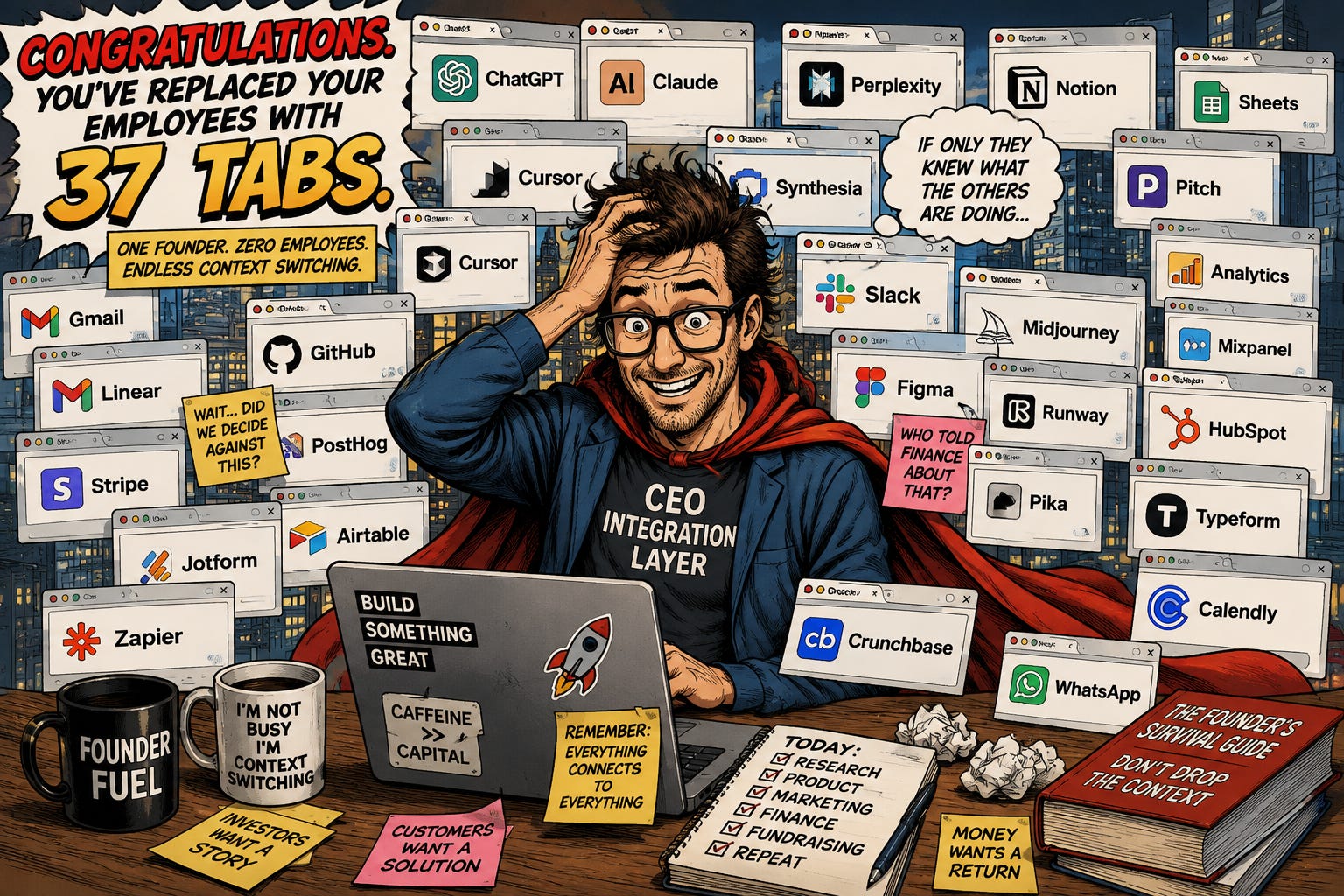
It begins innocently enough. ChatGPT helps with some research. Then you discover a better research tool, something clever for coding and an AI that makes presentations without requiring you to spend Sunday evening nudging boxes three pixels to the left. Six months later you have 14 subscriptions and have forgotten what three of them do. This is called productivity.

Startup Dreams, Mortgage Realities
The strange thing is that most of these tools are genuinely excellent. The research is better, the code arrives faster and things that once required a small team can now be done before lunch. Unfortunately, none of your artificial colleagues appears to have met. So the founder acquires a new job. You spend Monday morning explaining to one AI what another AI discovered on Friday. By lunchtime you’re copying a product decision somewhere else because the marketing AI is still enthusiastically promoting the feature you’ve just killed. At 3pm the fundraising AI resurrects it in the investor deck.
Nobody has employed a middle manager, which is excellent news, because you have become one. This is the slightly ridiculous state of the AI native startup. We have developed machines capable of writing software and reasoning over enormous quantities of information, then arranged them so that a human being has to wander between them carrying messages.
Somewhere, the inventor of the internal memo is feeling vindicated. The underlying mistake is treating a startup as a collection of jobs. It isn’t. A customer saying something unexpectedly rude about your product on Tuesday can change what gets built on Wednesday and make Friday’s revenue forecast look faintly embarrassing. Companies are chains of consequences disguised as departments.
37 Tab Founder Frenzy
That was manageable when execution was expensive. You had a marketing department because marketing required people, and a finance department because accountants became surprisingly territorial if you tried to do their work yourself. AI changes that bargain.
Yet our first instinct has been to recreate the old company in miniature and populate it with agents who never go to lunch but also never seem to talk to each other. Hence the emerging fashion for the AI employee. Soon every founder will apparently have an AI CFO, AI CMO and AI Head of Strategy. At the current rate, someone will launch an AI Chief Happiness Officer by Christmas and it will spend its days asking the other agents to complete an engagement survey.
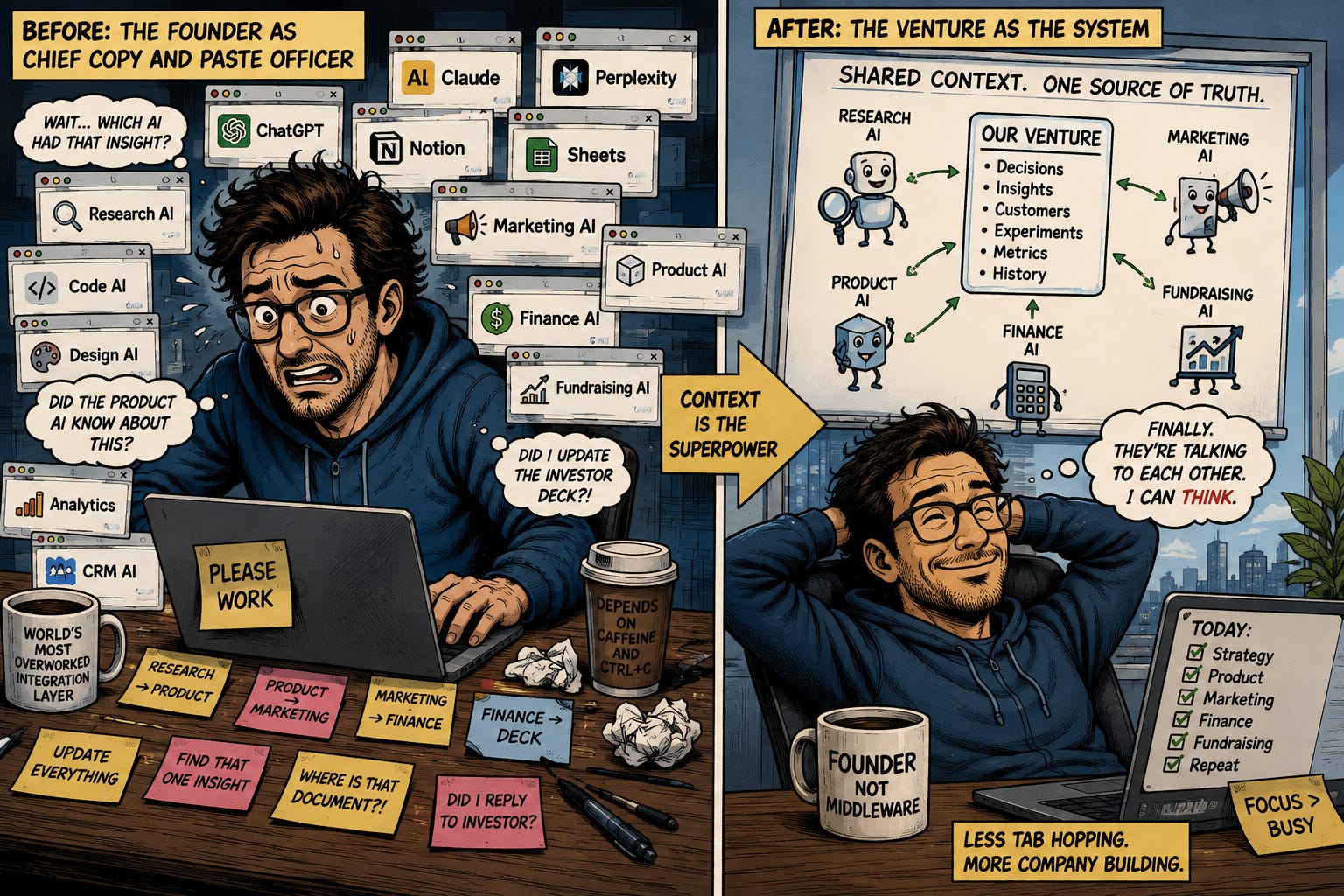
There is a more interesting possibility. Instead of making every task intelligent, you make it harder for the company to be stupid. That means the useful bit isn’t simply memory. Remembering that you decided something six months ago is nice, but remembering why you decided it becomes considerably more useful when someone proposes the same bad idea again wearing a different hat.
A company accumulates arguments, experiments, awkward customer conversations and expensive mistakes. Most software treats these as debris. But they may actually be the valuable bit. The models themselves will keep changing and today’s miraculous one will eventually be spoken about with the affection currently reserved for fax machines. The company’s accumulated context, meanwhile, becomes peculiar to the company.
From Tab Chaos to Shared Context
That’s the thinking behind what we’re building with LettsGroup VentureFactory. The interesting question for us isn’t how many AI agents a founder can command before developing the management problems they were supposed to eliminate. It’s whether the venture itself can become the shared system, so what is learned in one part of the company doesn’t have to be manually smuggled into another.
The founder doesn’t disappear in this version. They just stop being employed as human middleware. Judgement stays with the person who has money, reputation and possibly their house riding on the outcome, while the machines get on with the work they’re actually good at. Which leaves only one unresolved problem with the AI native company:
Finding the tab that’s playing music.
Keep up to date with The Letts Journal’s latest news stories and posts at our website and on twitter.