


America is now governed as if someone found a half-empty tub of stage greasepaint, a fistful of executive orders, and the remains of a three-day Diet Coke binge, then shouted: “Put it on Broadway.”
The obvious dramatic comparison is Oh, Mary! In that blessed fever dream, history is not so much revised as pickled, slapped with rouge, and shoved back onstage in heels. The central comic engine is chaos contained in a corset: need, vanity, resentment, impulse, and the desperate conviction that one is the star of a show no one else has properly understood.
Replace Lincoln with Trump and you barely need to alter the script. He is the same species of deranged theatrical gravity, only orange-tinted and armed with nuclear codes. He does not so much occupy the presidency as wear it incorrectly, like costume jewellery to a trial. He pouts, he sulks, he demands applause from furniture, he storms about the stage of state convinced that history is a personal inconvenience arranged by jealous understudies.
He is, in essence, a madcap President without the decency of period dress.
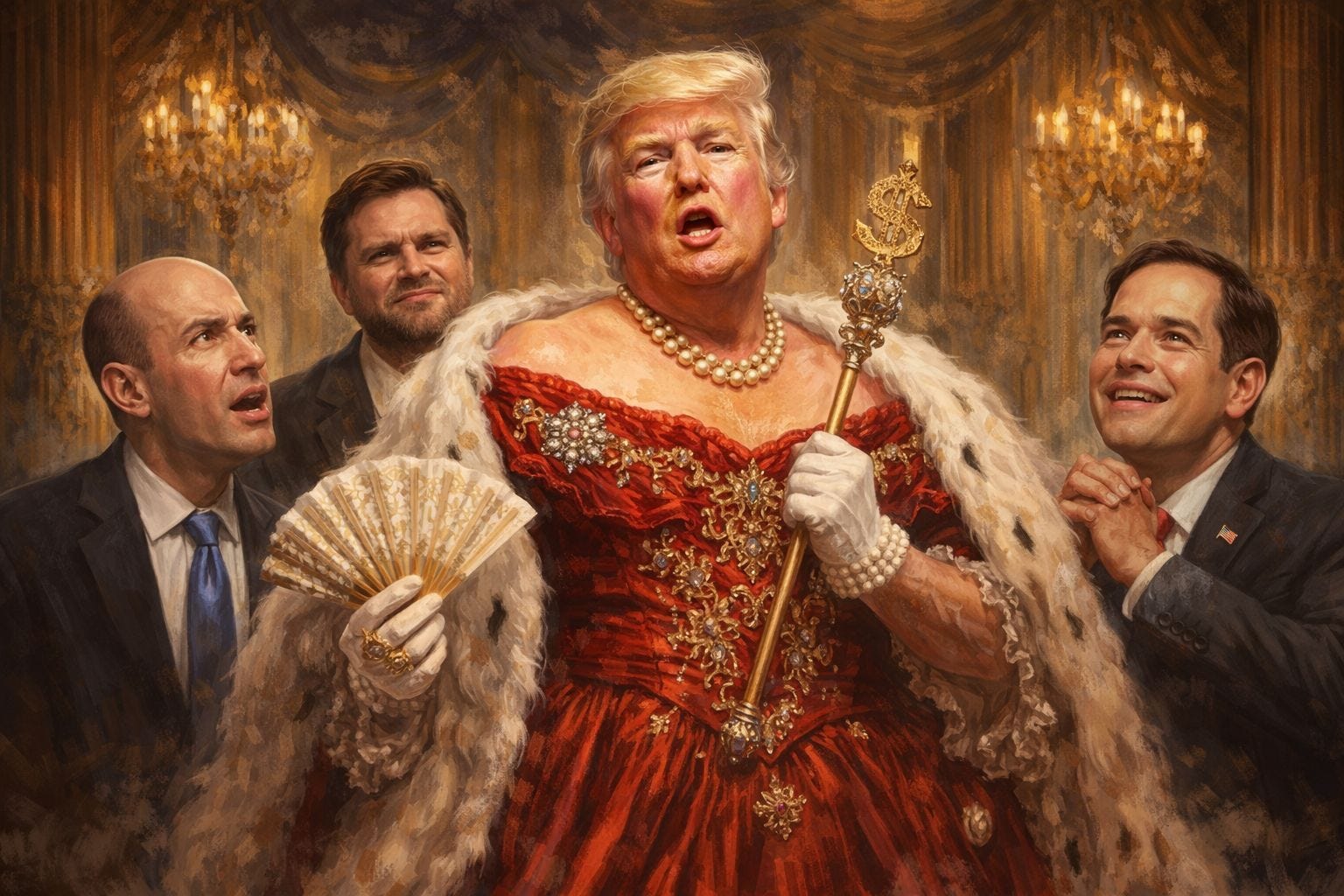
Trump’s great comic distinction is that he is a teetotaler who nevertheless behaves like a man who has been over-served by a casino bar at 2:17 a.m. His intoxicant is not gin but grievance. Not champagne but sugar. Not absinthe but the chemically perfect American slurry of Diet Coke, chocolate cake, cable television, and midnight social media delirium. Other leaders retire with briefing books; Trump climbs into bed with a glowing phone and emerges four hours later having declared war on punctuation, allies, and the concept of indoor voice.
He does not drink, and yet everything about him suggests a man who should be cut off.
In this production, Stephen Miller is the aide-de-camp, the grim little stage manager of national paranoia, forever skittering on and off with scrolls, memos, and the moral complexion of a candle stub. Miller has the air of someone who believes laughter should require a permit. One imagines him hovering in the wings, hissing, “Again, Mr President, but this time with more vengeance.”
And then there are the rotating emotional attachments, the political almost-paramours, switching between Marco Rubio and J.D. Vance depending on the needs of the scene. Rubio plays the role of the eager courtier who still seems faintly surprised to find himself in the room, as though he wandered in looking for seriousness and never found the exit. Vance, by contrast, has the sleek determination of a man who has studied the protagonist closely and decided that dignity is, in the end, a provincial habit. Both stand near the throne like men in a Restoration comedy waiting to discover whether they are confidants, suitors, or tomorrow’s discarded cast members.
But every farce requires a straight face in the middle of the hurricane, and here enters Melania.
She is not, in this rendering, the clown. She is the woman who married the clown and then discovered she had been cast in a national touring production with no closing date. Her role is harder. She must stand still while the wallpaper screams. She must wear expressionlessness like armour. She must embody that ancient dramatic function: the only person on stage who appears dimly aware that all of this is insane.
And yet even the straight woman in a farce has her trapdoor.
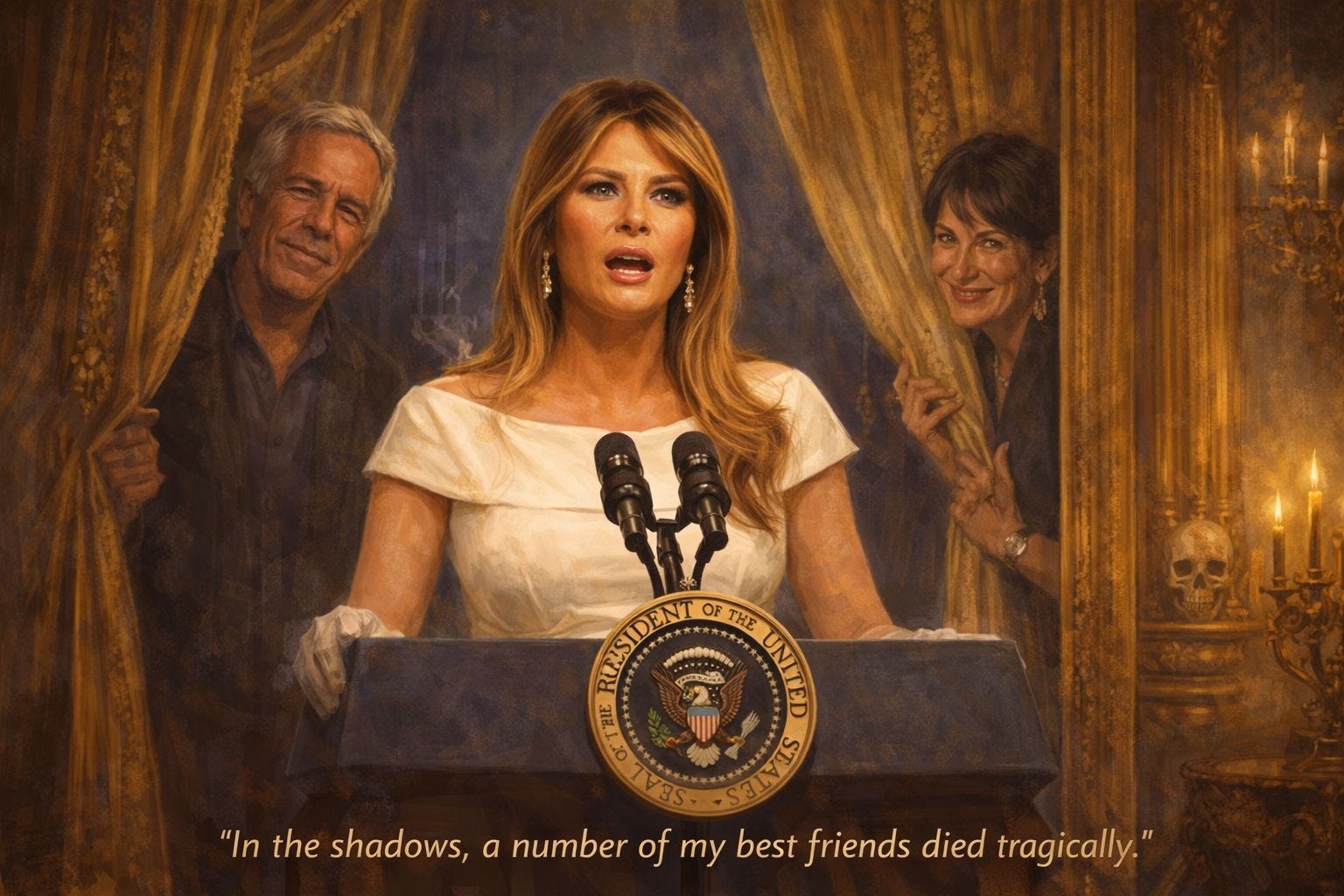
Melania’s public persona has always been built from immaculate surfaces: the accent preserved like crystal, the wardrobe weaponised into silence, the gaze suggesting that she has transcended embarrassment and now lives several floors above it. But there are moments when the lacquer cracks and something stranger flickers through: not confession, exactly, but the strain of a life spent as both symbol and hostage to symbols. Reinvention always has a tax bill. The administration may script the appearance, bless the backdrop, approve the podium, but there remains the eternal risk of live performance: the speaker may reveal a pulse.
Which brings us to that extraordinary phenomenon unique to the Trump era: no one ever seems entirely certain what anyone is going to say until they are already saying it from a government building. The White House, under Trump, functions less like a seat of executive power than an upscale escape room where staff members frantically try to guess which lever not to pull. Did anyone know what Melania was going to say when they approved the stage, the setting, the choreography of official dignity? Did they imagine restraint, solemnity, some lacquered platitude about nation and family? Or have they simply learned that in this administration, vetting is a superstitious ritual, like knocking on wood before the chandelier falls?
This is the true governing style of Trumpism: not authoritarian precision, as its enemies flatter it, but improvisational monarchy. A court of yes-men, grievance merchants, opportunists, and tense wives, all trapped in a production where the lead refuses rehearsal and regards continuity as an insult. The result is not efficiency but camp panic. Everyone is overacting except the people who are terrified they might.
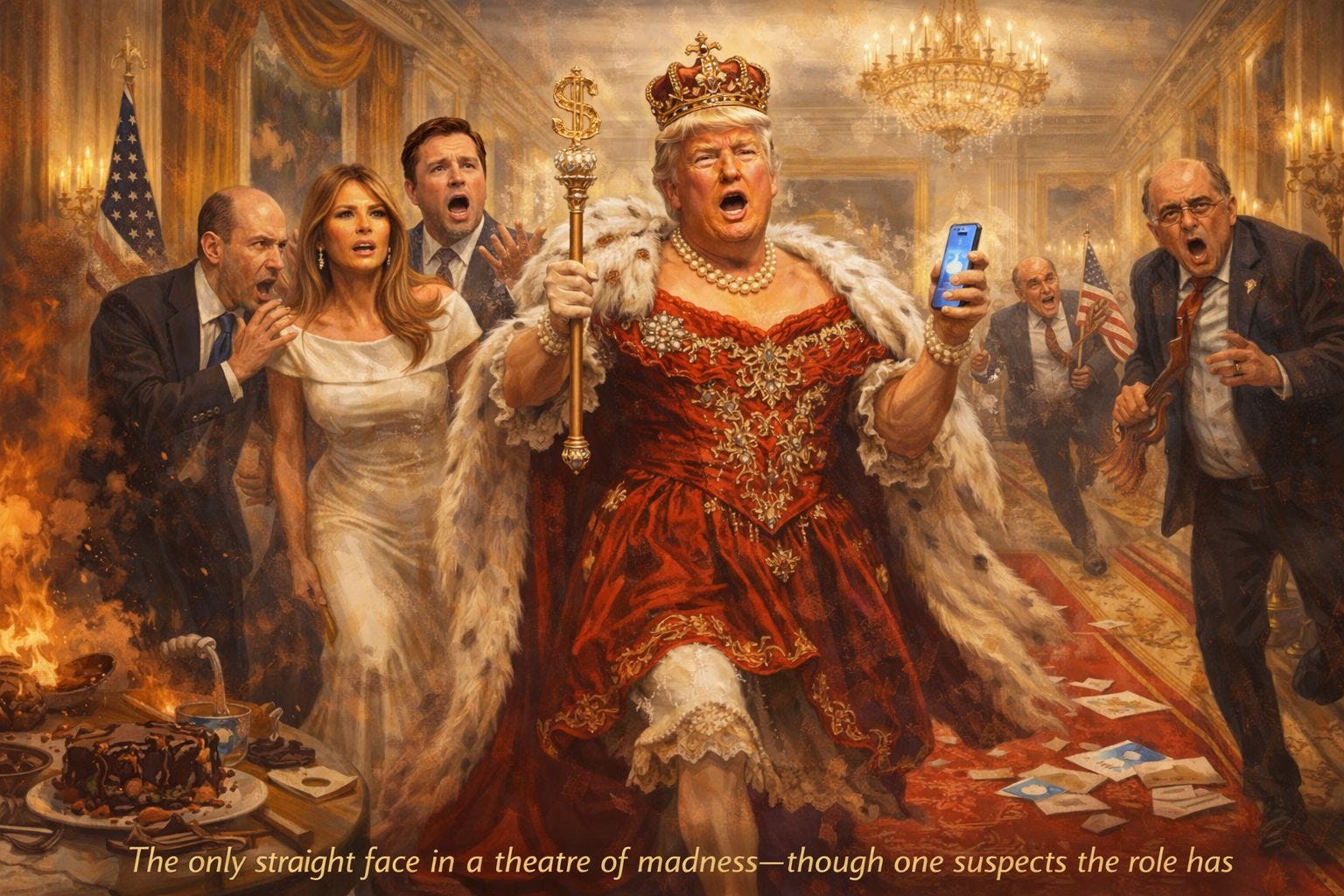
Like Oh, Mary!, the whole enterprise depends on the collision between official history and private derangement. Great events are driven not by noble principles but by petty appetites, wounded vanities, emotional substitutions, and the catastrophic consequences of someone needing attention at exactly the wrong moment. Trump understands this intuitively because he has never understood anything else. To him, statecraft is mood. Ideology is whatever gets the loudest hand. Loyalty is an aria sung by others. The republic is merely the stage on which his appetites may enter wearing a sash.
And still, absurdly, it works as theatre.
That is the appalling lesson. However threadbare the plot, however vulgar the set, however exhausted the audience, one cannot quite look away. Trump is not Lincoln in this production. He is Mary in the Lincoln role: all appetite, all performance, all need, stomping through the executive mansion in emotional costume jewellery, demanding to be adored while the nation’s adults search frantically for the exits.
The tragedy is political. The form is farce. The ticket price, as ever, is paid by everyone else. Is this reality or exquisite satire? God only knows.
Keep up to date with The Letts Journal’s latest news stories and posts at our website and on twitter.