


There is a particular kind of person who keeps getting back together with an ex they absolutely, definitively, categorically hate. They announce the breakup with great fanfare. They tell all their friends. They post about it. And then, six months later, there they are again, sheepishly holding a bunch of petrol-station flowers outside Tehran’s front door.
This week, Trump ordered fresh military strikes against Iranian-linked targets, re-entering active hostilities with the enthusiasm of a man who had briefly convinced himself he was done with the whole business. He was not done. He is never done. Nobody, it seems, is ever done with Iran. The conflict has been on, off, simmering, boiling, frozen, thawed, sanctioned, negotiated, collapsed, and reignited so many times that Pentagon planners presumably keep a laminated card on their desks that simply reads: “It’s Iran again. You know what to do.”
To call US-Iran relations volatile would be like calling Vesuvius a minor drainage issue. Since the Islamic Revolution, America has oscillated between treating Iran as an existential threat requiring immediate destruction and a rogue state that can probably be managed with the right paperwork. Trump himself has performed this particular dance with more enthusiasm than most. In his first term, he tore up the nuclear deal, assassinated Qasem Soleimani, and had Iran on the absolute brink — before somehow not quite finishing the job. Now, like a sequel nobody asked for but everyone knew was coming, here we are again. Iran 2: This Time It’s Personal (Again).
The Israel Question Nobody Wants to Answer Out Loud
Lurking behind all of this, like a dinner guest who hasn’t been formally introduced but is clearly running the seating plan, is Israel. The uncomfortable truth splitting Washington down the middle is whether the United States is pursuing its own strategic interests in confronting Iran, or whether it has, to put it diplomatically, subcontracted its foreign policy to Benjamin Netanyahu’s government and is now simply along for the ride.
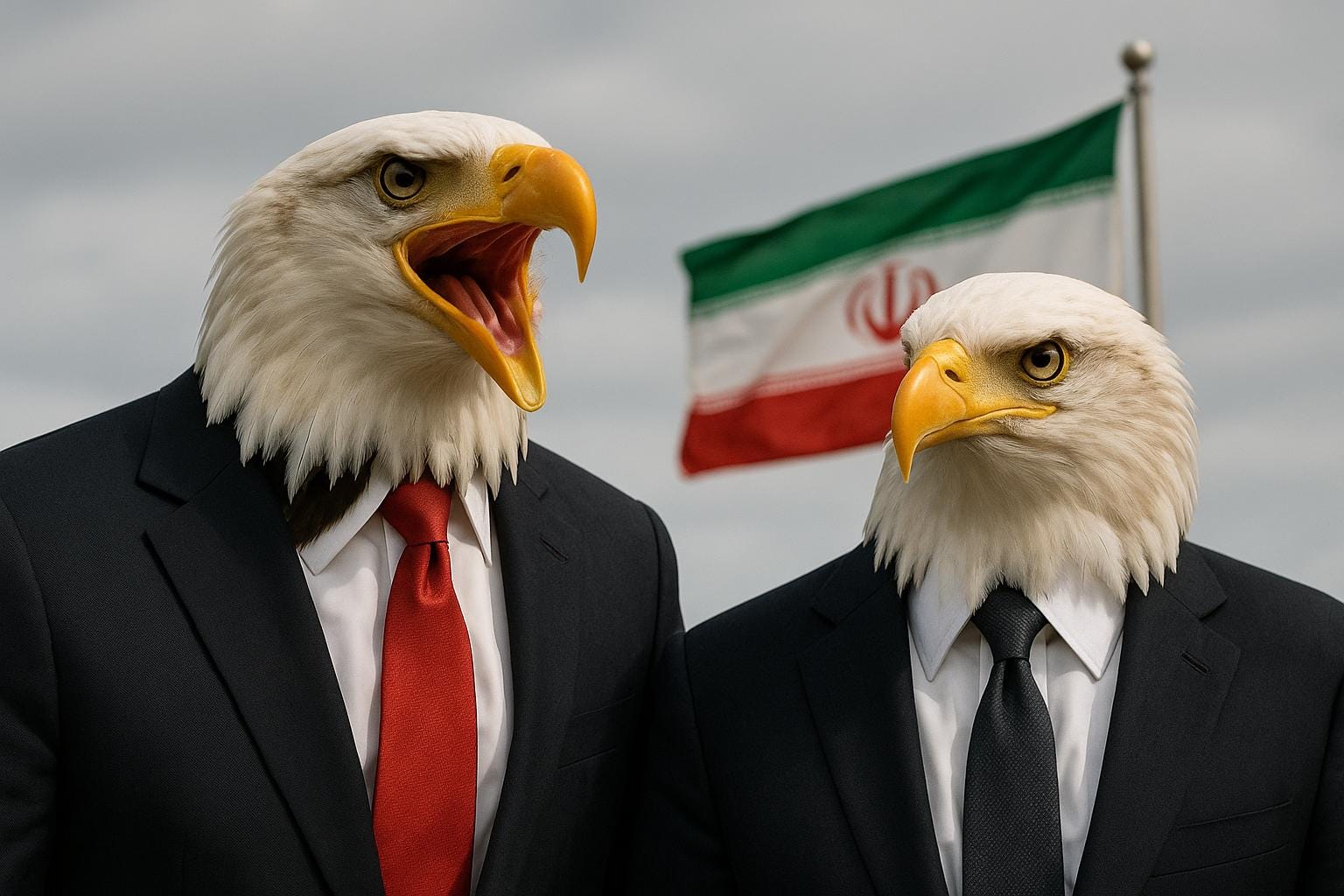
The hawks will tell you Iran is America’s problem because of its proxies, its missiles, its regional ambitions, and its persistent habit of funding people who wish Americans harm. The realists, and a growing, increasingly vocal contingent in both parties, will point out that the sequencing of every escalation with Iran tracks Israeli priorities with a precision that strains coincidence. When Israel bombs Iranian assets in Syria, Washington finds itself holding the bag. When Iran retaliates, America scrambles jets. It is an arrangement that benefits one party considerably more than the other, and that party is not the one funding it.
Trump, to his occasional credit, has shown flickers of awareness about this dynamic — before invariably doing what the more hawkish voices demand anyway. The result is a White House that simultaneously complains about being dragged into Middle Eastern conflicts and then enthusiastically dives headfirst into the next one. Remarkable, really.
The Weapon That Was There All Along
But here, buried beneath decades of hand-wringing about enriched uranium and centrifuges and the apocalyptic danger of Iran acquiring a nuclear weapon, is the joke that history has been quietly telling us, and which almost nobody in the serious foreign policy establishment has had the intellectual honesty to say out loud.
Iran doesn’t need a nuclear weapon. It never did. It has always possessed something arguably more immediately catastrophic: the ability to close the Strait of Hormuz.
The Strait of Hormuz is a narrow channel of water, barely 33 kilometres wide at its tightest point, through which approximately 20% of the world’s oil supply passes every single day. Saudi oil. Emirati oil. Kuwaiti oil. Qatari liquefied natural gas. All of it squeezes through this modest Persian Gulf bottleneck like the global economy through the eye of a needle. Iran sits on one side of it with missiles, mines, fast attack boats, and the absolute legal and physical capability to shut the whole thing down.
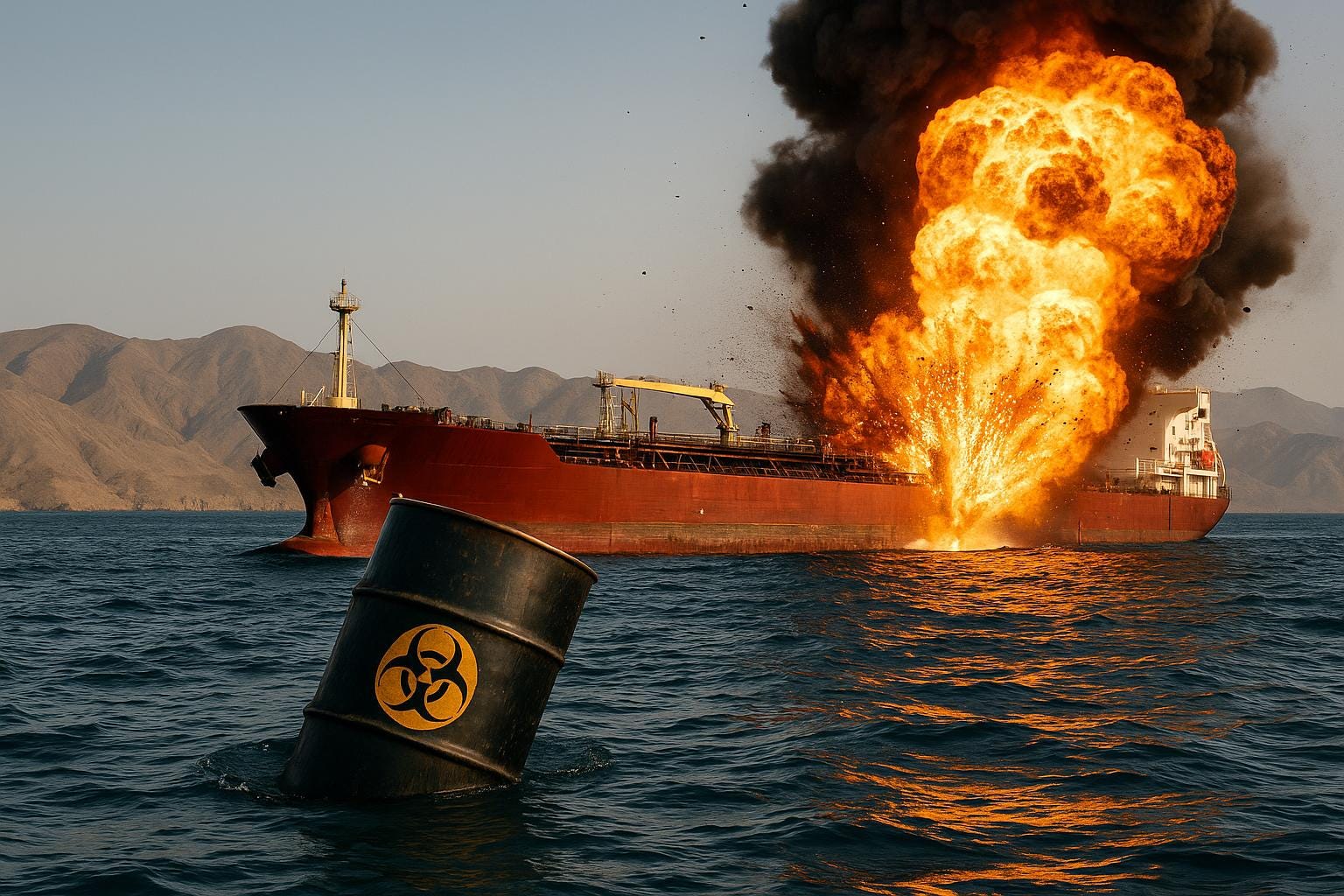
If Iran closes Hormuz, even for a couple of weeks, oil prices do not merely spike. They detonate. Global markets convulse. Supply chains fracture. Economies that have spent years pretending energy security is someone else’s problem suddenly discover, with great urgency, that it is very much their problem. The economic damage of a sustained Hormuz closure would dwarf almost any conventional military exchange in modern history. It is, in every meaningful sense, an economic nuclear weapon — and Iran has been quietly sitting on it for forty years while the world fretted about its centrifuges.
The Irony Is Weapons-Grade
Think about what this means for a moment. The entire architecture of Western policy towards Iran — the sanctions, the sabotage, the assassinations, the on-off negotiations, the endless UN resolutions, the Stuxnet virus, the sleepless nights in Washington about a potential Iranian bomb — was constructed on the premise that a nuclear-armed Iran would be uniquely, existentially dangerous. Deterrence would collapse. The Middle East would go up like a July 4th parade on meth. Civilisation, broadly speaking, would have a bad Tuesday.
And yet Iran, even without the bomb, even fully sanctioned, even with its nuclear programme repeatedly set back, has held a weapon of comparable economic destructiveness this entire time. The Hormuz card. The one that requires no enrichment, no warhead, no intercontinental delivery system. Just some mines, some political will, and an afternoon.
One is forced to conclude one of two things. Either Western policymakers understood this perfectly well and have been catastrophising about the nuclear programme as a more politically legible threat, one with clear villains, clear red lines, and photogenic satellite imagery, while quietly hoping nobody does the Hormuz maths. Or they genuinely didn’t fully reckon with it, which is, if anything, more alarming.
Either way, Trump has now re-entered hostilities with a country that could, should it choose, send petrol to four pounds a litre before the month is out. Whether he has gamed this out thoroughly is, given the available evidence, an open question. Whether anyone around him has is another. The on-off relationship continues. The economic weapon sits there, safety off, pointed squarely at the global economy. And somewhere in Tehran, one imagines, someone is doing the maths and smiling very quietly indeed. Looking a bit like Mike Myers.
Keep up to date with The Letts Journal’s latest news stories and posts at our website and on twitter.