


Historians generally agree that history turned on a knife edge in the summer of 2023. In one timeline, Keir Starmer became Prime Minister. In another, Andy Burnham emerged from Greater Manchester, crossed the Pennines like a latter-day Arthur Pendragon, and entered Downing Street promising to rebuild Britain through a combination of economic intervention, regional empowerment and the radical proposition that places outside London might occasionally matter. This is the story of that second Britain.
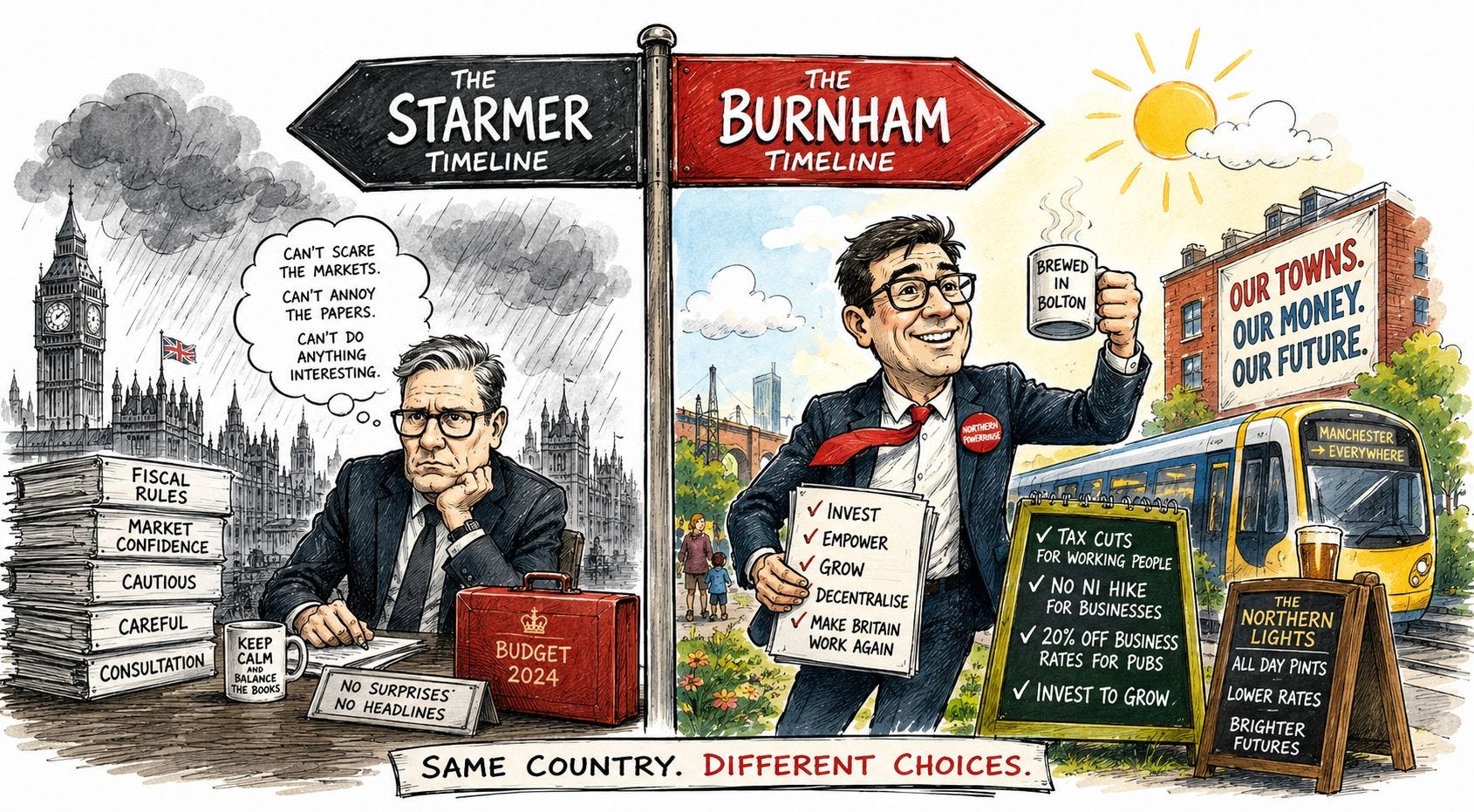
The Burnham Timeline.
The Britain that might have been. Or, depending on your perspective, the Britain from which we were mercifully spared.
The first signs of divergence appeared almost immediately. While Prime Minister Starmer spent his first months reassuring markets, Prime Minister Burnham spent his alarming them. Not intentionally, of course. Burnham simply entered office with a genuinely unusual belief: that governments occasionally exist to do things. This placed him in immediate conflict with the Treasury, the Bank of England, the bond markets, several economics correspondents, and a man in Tunbridge Wells who writes seventeen letters a week to The Telegraph explaining why Britain peaked in 1956. Unlike Starmer and Rachel Reeves, Burnham never entirely accepted the modern Westminster doctrine that government exists primarily to reassure financial markets.
His view was simpler. Britain was visibly falling apart. Perhaps some money should be spent fixing it. The reaction was immediate. Economists appeared on television looking physically unwell. The Financial Times ran fourteen consecutive editorials containing the phrase “market confidence.” A senior Treasury official reportedly fainted after hearing the words “borrow to invest.” Yet Burnham persisted.
His first Budget was described by one commentator as “a cross between Keynesian economics and a particularly ambitious council regeneration scheme.” Personal income tax allowances rose. The planned National Insurance increase on employers was scrapped. Business rates for pubs were cut. Small businesses received higher tax-free thresholds. Infrastructure spending surged. And for a brief period the nation experienced the deeply unfamiliar sensation of a government attempting to make voters happier rather than merely less angry.
The consequences were extraordinary. Within months every pub in Britain had declared itself a strategic national asset. Landlords who had not smiled since the Major administration suddenly developed political opinions. The Chancellor was eventually forced to clarify that economic growth did not technically include beginning Tuesday afternoon drinking sessions at eleven-thirty in the morning. Burnham’s broader vision proved even more unsettling.
For decades Britain had operated on the assumption that every important decision should be made by approximately six people in Westminster. Burnham regarded this arrangement as mildly insane. Power began flowing outwards. Mayors gained influence. Regional authorities gained budgets. Councils gained responsibility. Local leaders discovered they could occasionally make decisions without first obtaining permission from somebody called Oliver in Whitehall. The Westminster establishment reacted as if wolves had been released into Buckingham Palace.
Political journalists became increasingly confused. Who exactly were they supposed to blame for things? In Starmer’s Britain every story eventually led back to Westminster. In Burnham’s Britain half the country appeared to be governing itself. This was considered deeply irresponsible. Particularly by Westminster.
Internationally, Burnham quickly established himself as a new kind of statesman. Previous British prime ministers travelled the world discussing trade, security and geopolitics.Burnham travelled the world discussing investment, regional development and why cities should have more control over their own futures. At one G7 summit he reportedly spent twenty minutes explaining the economic potential of northern England to bewildered world leaders. The Germans found the argument surprisingly persuasive. The French considered it a personal insult. The Americans assumed Manchester was a suburb of London.
The most fascinating consequences, however, appeared inside the Labour Party itself. Because Burnham had actually won. The Labour Right could not complain he was too left-wing. The Labour Left could not complain he was too centrist. The result was a rare period of ideological peace in which both factions simply complained about each other out of habit. Labour slowly began behaving like Labour again. Trade unions became visible. Local activists stopped speaking exclusively in LinkedIn posts. Cabinet ministers occasionally sounded as though they possessed actual opinions.
The atmosphere became energetic. Which immediately caused panic. By 2025 Labour politicians were openly disagreeing with one another. The BBC treated this as a constitutional emergency. Commentators warned of factionalism. The public struggled to understand the problem. Hadn’t politicians always disagreed? Apparently not. Not since focus groups were invented.
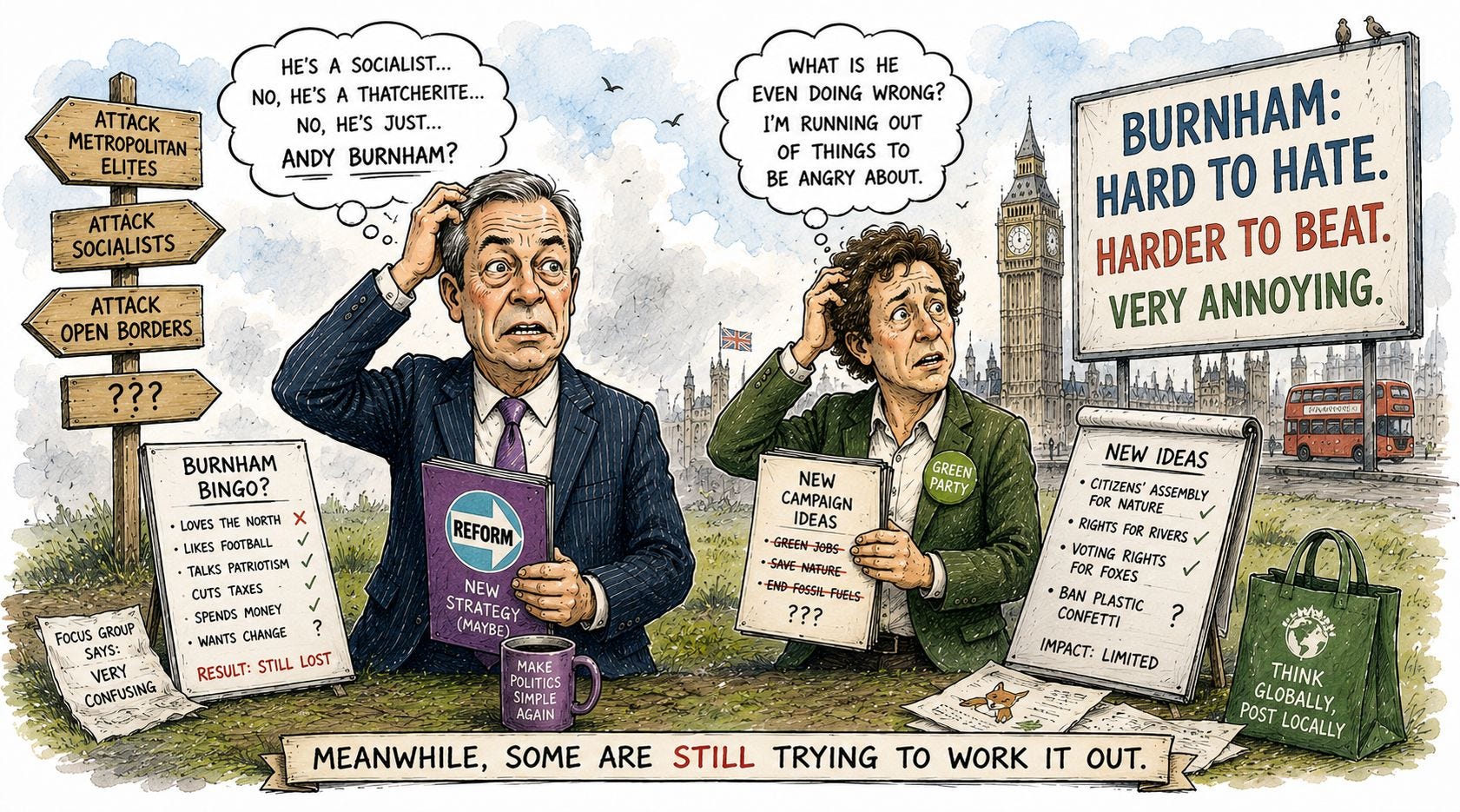
Meanwhile Nigel Farage’s Reform Party continued its rise. In fact, it rose even faster than it has in our own timeline. This created an unexpected strategic dilemma. Farage’s entire political model depends on identifying an out-of-touch metropolitan establishment and repeatedly hitting it with a stick. The difficulty was that Burnham was annoyingly hard to portray as a member of that establishment. He talked about patriotism. He talked about manufacturing. He talked about towns outside London. He liked football. He occasionally appeared to have met ordinary voters. This was deeply inconvenient.
Whenever Reform attacked metropolitan elites, voters would point out that the Prime Minister spent most weekends opening factories in Bolton and discussing industrial strategy. Reform strategists found themselves trapped. Burnham supported immigration controls. He advocated investment. He talked constantly about working-class communities. He cut taxes for ordinary workers. He spent public money. He was, in short, annoyingly difficult to fit into a campaign leaflet.
For eighteen months Reform alternated between describing him as a dangerous socialist and a secret Thatcherite. Neither line gained traction. Eventually the party settled on accusing him of being Andy Burnham. Polling suggested this was less effective than hoped.
The Green Party faced a different problem entirely. Without Starmer to oppose, and with Burnham enthusiastically discussing regional investment, housing development and public ownership every fifteen minutes, the Greens struggled to identify precisely what they were protesting against. Zack Polanski launched several imaginative campaigns. One demanded a Citizens’ Assembly for Nature. Another proposed constitutional representation for rivers. Both generated considerable media attention. Neither received overwhelming support from the rivers.
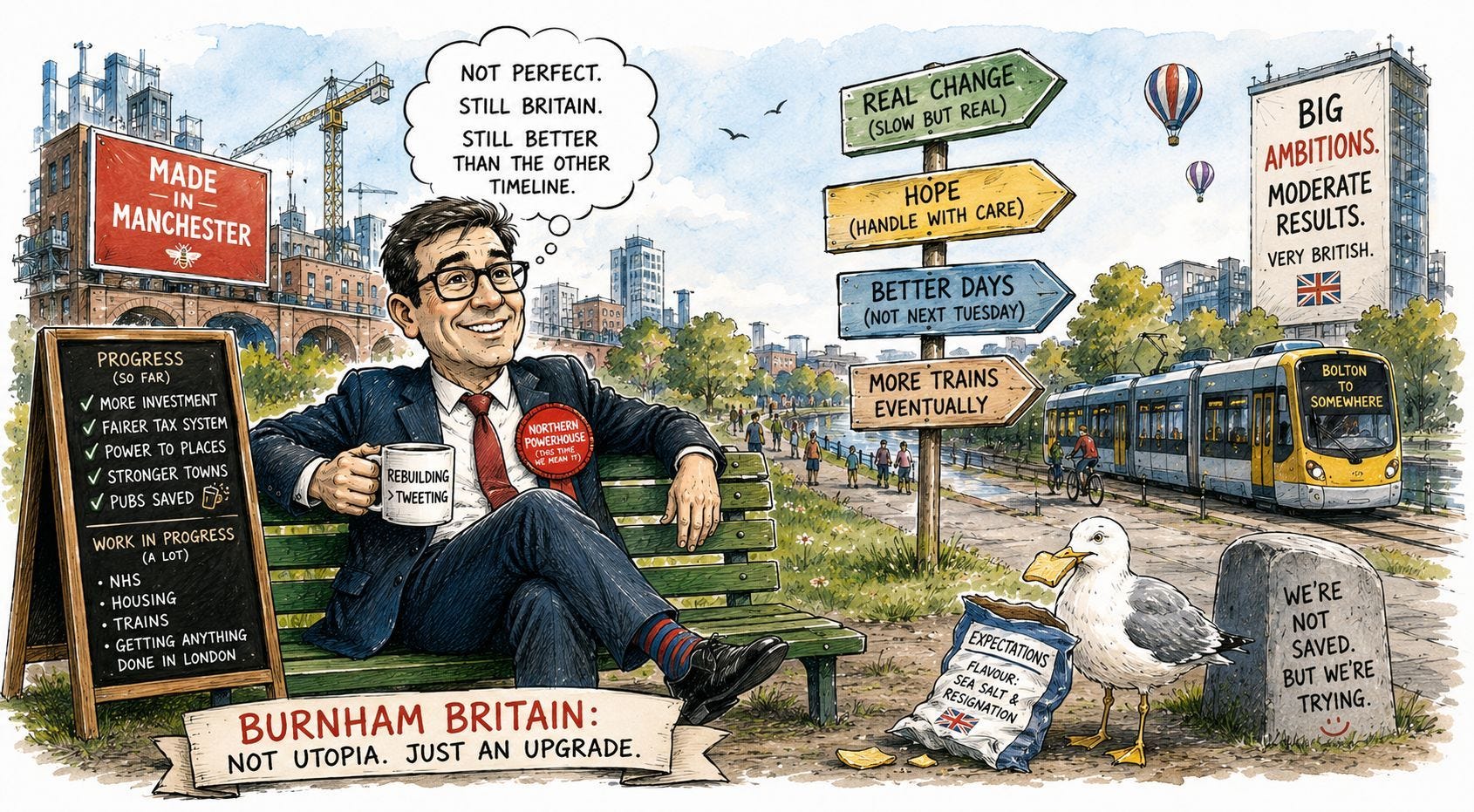
By 2026 Britain remained recognisably Britain. The NHS still struggled. Housing remained expensive. Trains remained late. The economy remained stubbornly British. No Prime Minister, not even Burnham, could solve those problems entirely.
But the national atmosphere felt different. There was a growing sense that somebody, somewhere, was at least trying. This caused significant distress among political commentators. The British political ecosystem relies heavily upon a careful balance of cynicism, disappointment and managed decline. Burnham threatened that balance. How could newspapers portray him as detached when he spent every weekend visiting actual places? How could they accuse him of ignoring the regions when half the government seemed to live in them? How could they describe him as a Westminster insider when he spent most of his career complaining about Westminster?
By 2026 the principal opposition to Burnham was no longer Reform. It was exhaustion. The country had simply reached its maximum safe exposure to municipal optimism. Voters began reporting symptoms. An interest in local government finance. Unexpected enthusiasm for industrial strategy. The belief that government investment might occasionally be useful. In severe cases, hope.
Today historians remain divided about the Burnham Timeline. Some argue Britain would have been wealthier. Others argue it would have looked remarkably similar. Most agree that prime ministers rarely change outcomes as much as their supporters imagine. But they do change atmospheres.
Starmer’s Britain often feels like a company undergoing restructuring. Burnham’s Britain would probably have felt like a country trying to rebuild itself. Neither vision is revolutionary. Neither creates utopia. Neither prevents Nigel Farage appearing on television. But one of them occasionally sounds like it believes Britain might still be worth investing in.
And in modern politics, that almost counts as radicalism.