


There was a time when conspiracy theorists occupied a reassuringly familiar place in society. They stood outside the village pub explaining that the moon landing was filmed in a warehouse in Slough while everyone else quietly edged towards the fire exit. Every community had one. They were harmless, eccentric and usually identifiable by a corkboard covered in red string. Then someone gave them YouTube.
We still talk about “the mainstream media” as though it consists of the BBC, The New York Times, ITV News, CNN and a man in a sensible tie apologising for interrupting The Antiques Roadshow. That world still exists, but it is no longer where most opinions are formed. Millions of people now receive their understanding of politics, economics, science and society from people who have never worked in a newsroom, never answered to an editor and never had anyone ask the deeply inconvenient question, “Are you absolutely sure that’s true?”
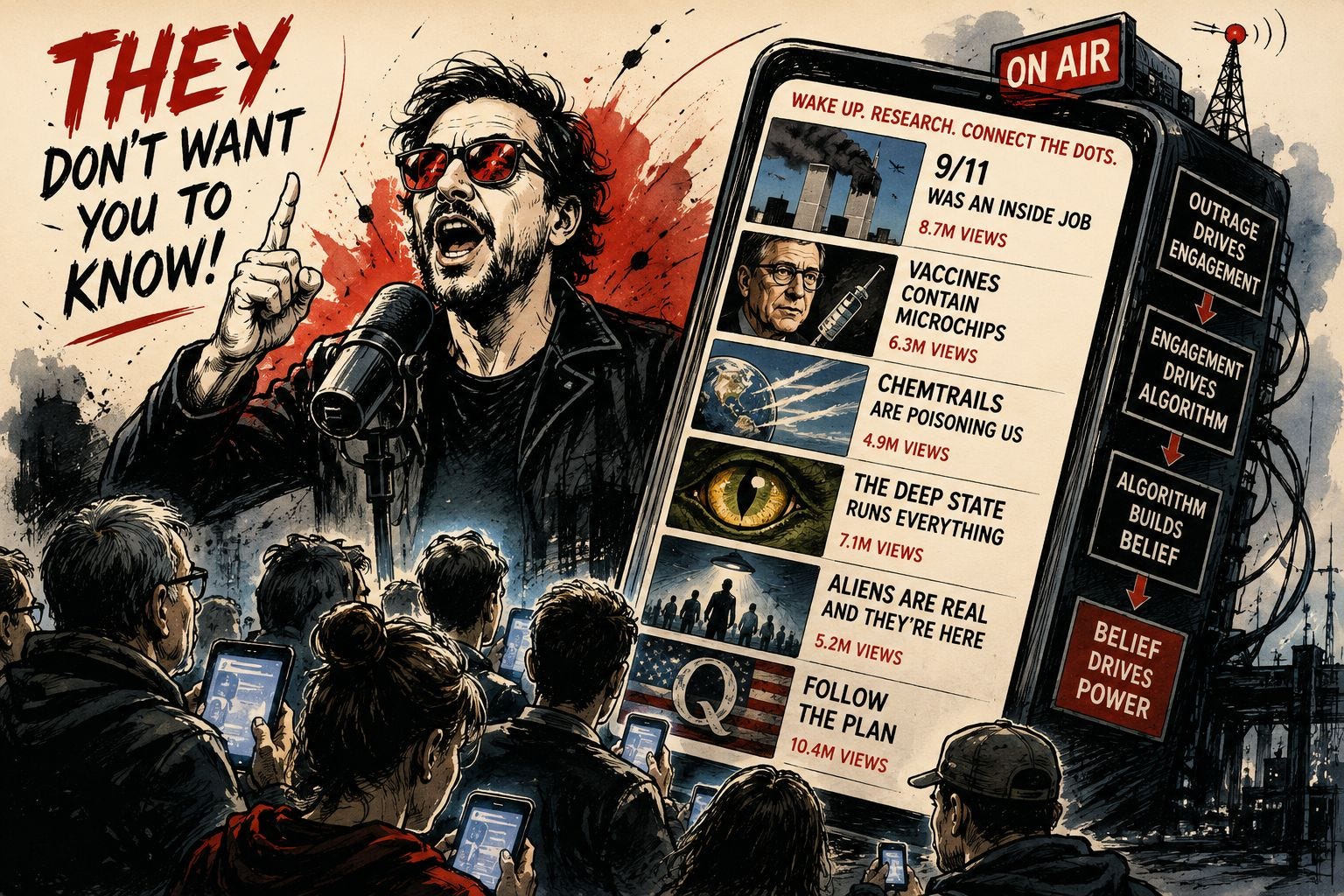
The conspiracy theorists did not defeat the mainstream media. They built another a new media. This new media has presenters, correspondents, documentaries, investigative journalists, breaking news banners, premium subscriptions, advertising deals and loyal audiences. It has heroes and villains. It has its own celebrities, its own experts and its own villains of the week. Most importantly, it has discovered something newspapers have always known. Belief is a business.
The internet promised to democratise knowledge. Instead, it democratised publishing. Those are not the same thing. Gutenberg accidentally helped create the Enlightenment because printing books spread ideas. Silicon Valley accidentally created the largest belief factory in human history because it discovered that outrage keeps people staring at glowing rectangles for just a little bit longer. Nobody at YouTube sat around a conference table asking how to undermine liberal democracy. Nobody at TikTok decided the future required convincing otherwise sensible adults that Taylor Swift is secretly directing Pentagon weather satellites. The algorithm is not ideological. It is commercial. It has only one job. Keep you watching.
Unfortunately, attention and truth have never enjoyed a particularly close relationship. Imagine you are the algorithm. A thoughtful discussion about fiscal policy arrives on your desk. Moments later another video appears with a red arrow, three exploding emojis and the words “THEY LIED TO YOU.” Which one keeps people watching for another ten minutes? Which one generates furious comments? Which one persuades someone to send it to six friends before breakfast? The algorithm has no opinion on immigration, climate change, transgender rights or taxation. It simply notices that human beings are gloriously incapable of resisting certainty wrapped in emotion. It has quietly rediscovered what newspaper barons, television producers and tabloid editors spent a century learning. Outrage sells.
The political consequences have been profound. The populist right has understood this ecosystem faster than almost anyone else. Tucker Carlson no longer needs a television network to command an audience that rivals one. Candace Owens reaches millions by speaking directly into a camera. Charlie Kirk has built an organisation that functions as much like a media company as a political movement. Fox News increasingly resembles a bridge between the old media and the new, borrowing the rhythms of social media while retaining the authority of television. In Britain, GB News has created an entirely different political conversation, proving that there was a significant audience waiting for an alternative to the broadcasting consensus.
None of this means the arguments of the populist right are necessarily wrong. Some are persuasive, others plainly are not. The point is that their extraordinary success cannot be explained simply by examining the quality of their ideas. They have mastered the economics of modern attention. They understand that a ninety second clip matters more than a ninety minute parliamentary debate. They know that confidence spreads faster than caution and that declaring civilisation to be collapsing will always outperform admitting that public policy is, regrettably, rather complicated.
It would be comforting to pretend this is exclusively a phenomenon of the right. It is not. The left has its own activist influencers, ideological YouTubers and online personalities whose audiences also reward certainty over complexity. Yet there is a noticeable difference. The contemporary right has produced a remarkable number of media entrepreneurs whose influence now rivals, and in some cases exceeds, traditional broadcasters. They are no longer commentators on politics. They are political institutions.
At the same time, there are encouraging signs that another model still has a future. Few people predicted that one of Britain’s most successful political podcasts would consist largely of Alastair Campbell and Rory Stewart doing something almost revolutionary. Listening to each other. The Rest Is Politics has become a remarkable success precisely because it refuses to manufacture permanent outrage. It trusts its audience to tolerate uncertainty. It demonstrates that millions of people are still willing to spend an hour listening to two intelligent adults admit that complicated questions rarely produce simple answers.
Across the Atlantic, The Atlantic has quietly staged one of journalism’s most surprising revivals. While much of the industry has chased clicks like a Labrador chasing tennis balls, it has doubled down on reporting, editing and long form analysis. It has built a profitable business by making a rather old fashioned wager that there are still enough readers who value careful thinking over emotional theatre.
One wonders whether there is an equivalent standard bearer on today’s conservative side. Historically there were publications such as National Review in America or The Spectator in Britain, magazines that prized ideas over personalities. Today the centre of gravity has shifted elsewhere. Conservative attention increasingly flows towards individuals rather than institutions. People no longer ask what a newspaper thinks. They ask what Tucker thinks. Or Candace. Or whichever narrator the algorithm has decided should explain the world this week.
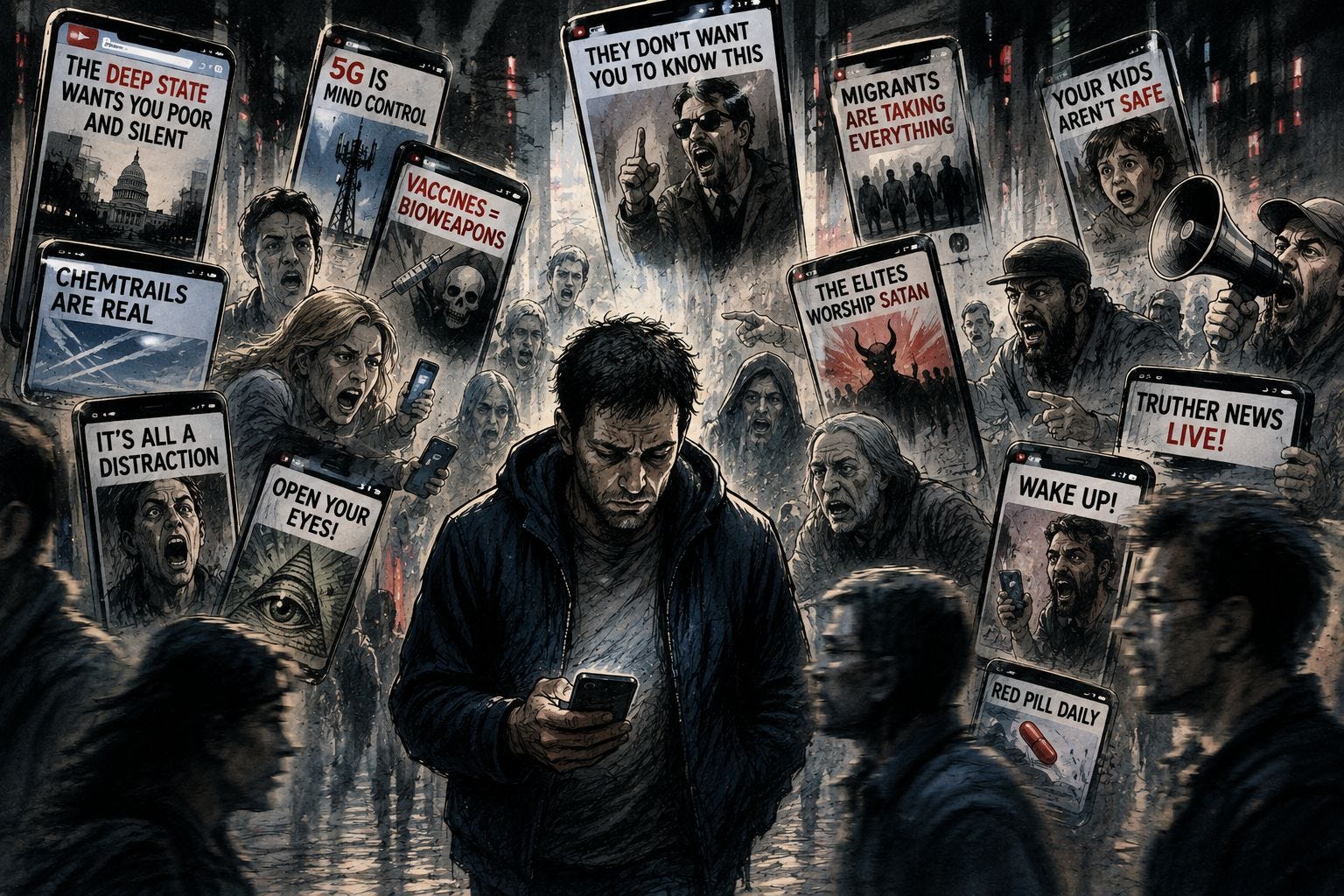
Perhaps that is the biggest transformation of all. We no longer trust institutions. We trust narrators. The most unsettling aspect of this revolution is how invisible it is. We imagine ourselves making independent choices, yet every click teaches the algorithm a little more about us. Every recommendation becomes fractionally more provocative than the last. Every thumbnail a little more dramatic. Every presenter a little more certain. Nobody falls down the rabbit hole in a single leap. They wander into it one autoplay at a time.
Psychologists have long understood that familiarity breeds credibility. We are more likely to believe something we encounter repeatedly, even if we cannot remember where we first heard it. The algorithm exploits this quirk with breathtaking efficiency. The people living next door probably have not changed very much. The people living inside your phone have. Increasingly, they know you better than your neighbours do, they speak to you for longer, and they slowly become the voices you trust. Elections are no longer fought only in town halls or television studios. They are fought inside millions of individually curated realities.
We like to imagine our opinions are formed by experience. Increasingly, they are formed by repetition. Not because somebody ordered us to think differently, but because the same handful of voices appear on our screens every day until familiarity starts to feel like truth. The algorithm does not change your mind overnight. It quietly changes what feels normal.
That may be the most remarkable achievement of all. The twentieth century taught us to fear governments that controlled information. The twenty first may require us to think much harder about markets that optimise it. Nobody instructed the algorithm to produce division. Nobody ordered it to reward certainty or punish nuance. It simply discovered, through billions of tiny experiments, that anger is profitable, certainty is addictive and complexity is terrible for engagement. The market optimised for attention. Politics adapted and journalism followed.
The result is a world in which podcasters, YouTubers and commentators now face exactly the same ethical questions that newspaper editors once did. Are you merely asking questions, or are you shaping beliefs? Once your audience numbers in the millions, can you honestly claim you are simply having a conversation? If your livelihood depends upon keeping people emotionally invested, how many creators can resist becoming just a little more certain than the evidence allows?
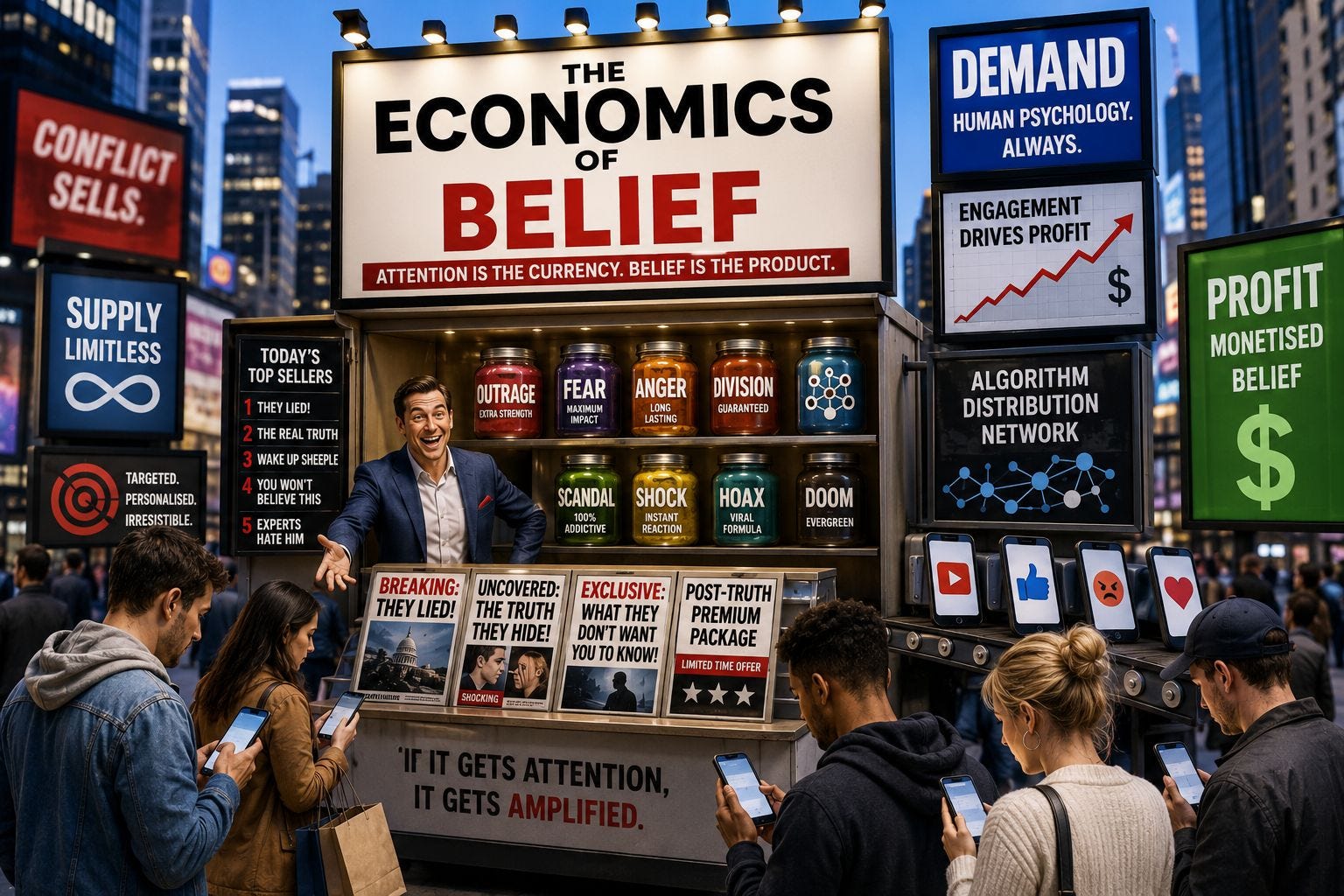
We have spent the last century worrying about the economics of oil, the economics of trade and the economics of labour. We have paid far less attention to the economics of belief. Yet belief has quietly become the most valuable commodity of all. It is bought with attention, traded through algorithms and monetised with advertising. The winners are not always those with the strongest evidence. Increasingly, they are those with the strongest business model.
Perhaps the defining political question of the next decade is no longer simply who governs us. It is who profits from what we believe. Because if markets now determine which ideas rise, which voices dominate and which stories become our reality, then before we ask who won the argument, perhaps we should ask a much simpler question.
When every influencer has a television studio, every citizen has a printing press and every algorithm has become an invisible editor, where will we get our news, who will we trust, and how will we know that what we believe is actually true?