


There is a particular kind of political agony reserved for leaders who are not quite dead yet. Not the clean, merciful bullet of a dramatic resignation. Not the dignified exit of someone who reads the room and quietly orders a taxi. No — Keir Starmer appears destined for something far crueller: the prolonged, public, excruciatingly British humiliation of a man being pushed out of his own party whilst everyone argues loudly about the precise speed at which he should fall.
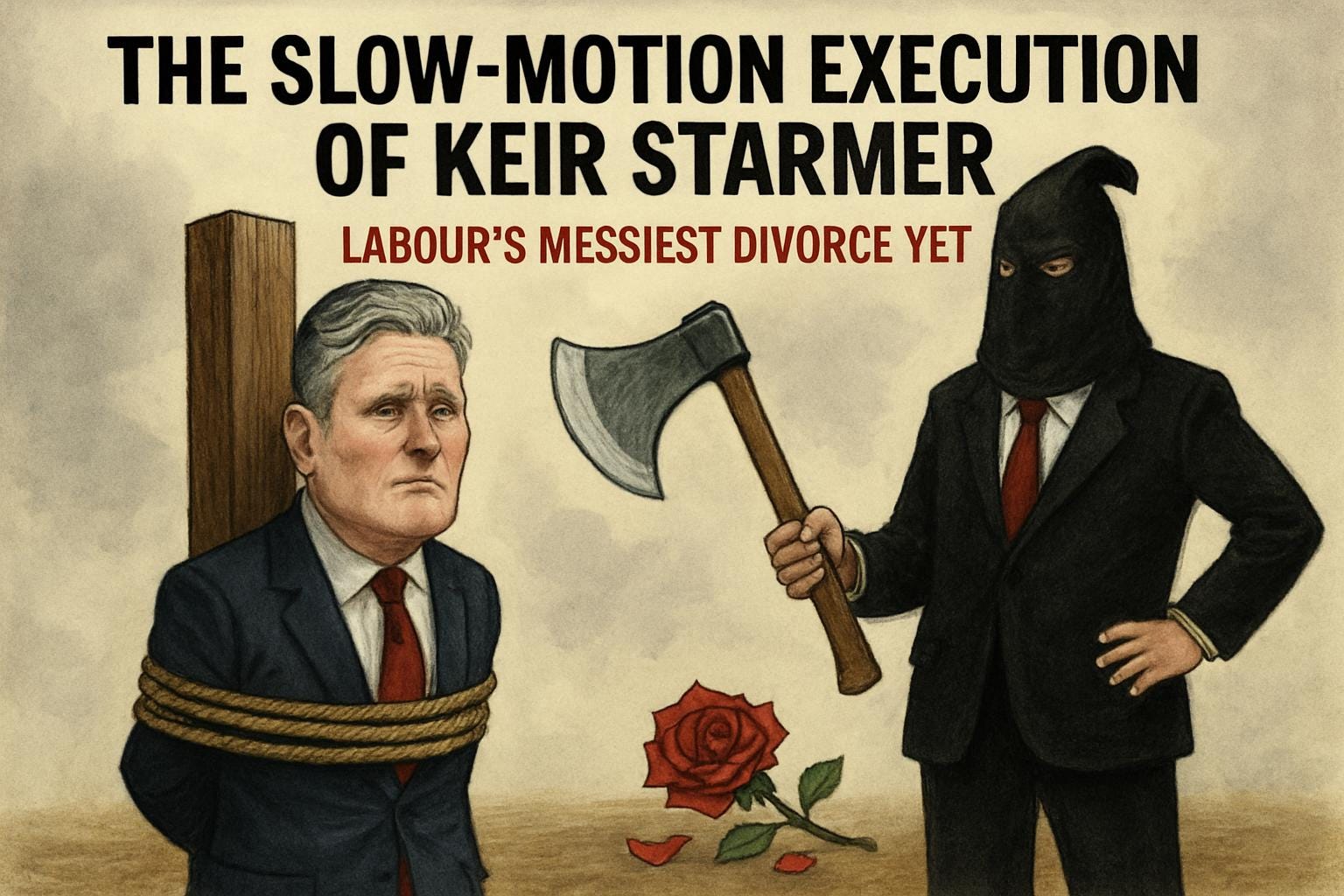
Welcome to Labour, 2026. Pull up a chair. This is going to get messy.
The Elections That Broke the Dam
To understand how we got here, you need to look at what happened in the local elections — and brace yourself, because the numbers are not pretty. Labour did not merely underperform. Labour was comprehensively mugged in broad daylight by two parties simultaneously pulling voters in opposite directions, like a man being stretched on a very ideological rack.
On the right flank, Nigel Farage’s Reform UK continued its improbable transformation from pub-bore pressure group to genuine electoral force, hoovering up working-class voters in the Midlands and the North who looked at Labour’s first year in government and decided that, on reflection, they’d rather vote for a man who looks like he runs a slightly dodgy car dealership. Reform’s gains were not just symbolic. They were structural. They are eating Labour’s traditional vote like a very confident woodworm.
On the left flank, the Greens had an equally rampant evening, picking up council seats with the kind of confidence that comes from representing voters who bought an electric car three years ago and have never quite got over it. Young, urban, disillusioned with Starmer’s relentless centrism and his government’s rather creative relationship with its own manifesto commitments — these voters did not go back to the Tories. They went Green. In some cases, they went very Green indeed.
The result was a political pincer movement that left Labour squeezed from both sides, staring at a map of England that looked less like a governing coalition and more like a warning.
A Man Receiving His P45 in Instalments
Into this wreckage stepped Keir Starmer, a man who has spent his entire premiership looking faintly surprised that anyone expected governing to be this difficult. To be fair to him — and this column is rarely fair to anyone — Starmer inherited a genuinely awful fiscal situation, a party that had lost four elections on the trot, and a media landscape that treats any Labour government with the warmth of a damp January in Stoke-on-Trent.
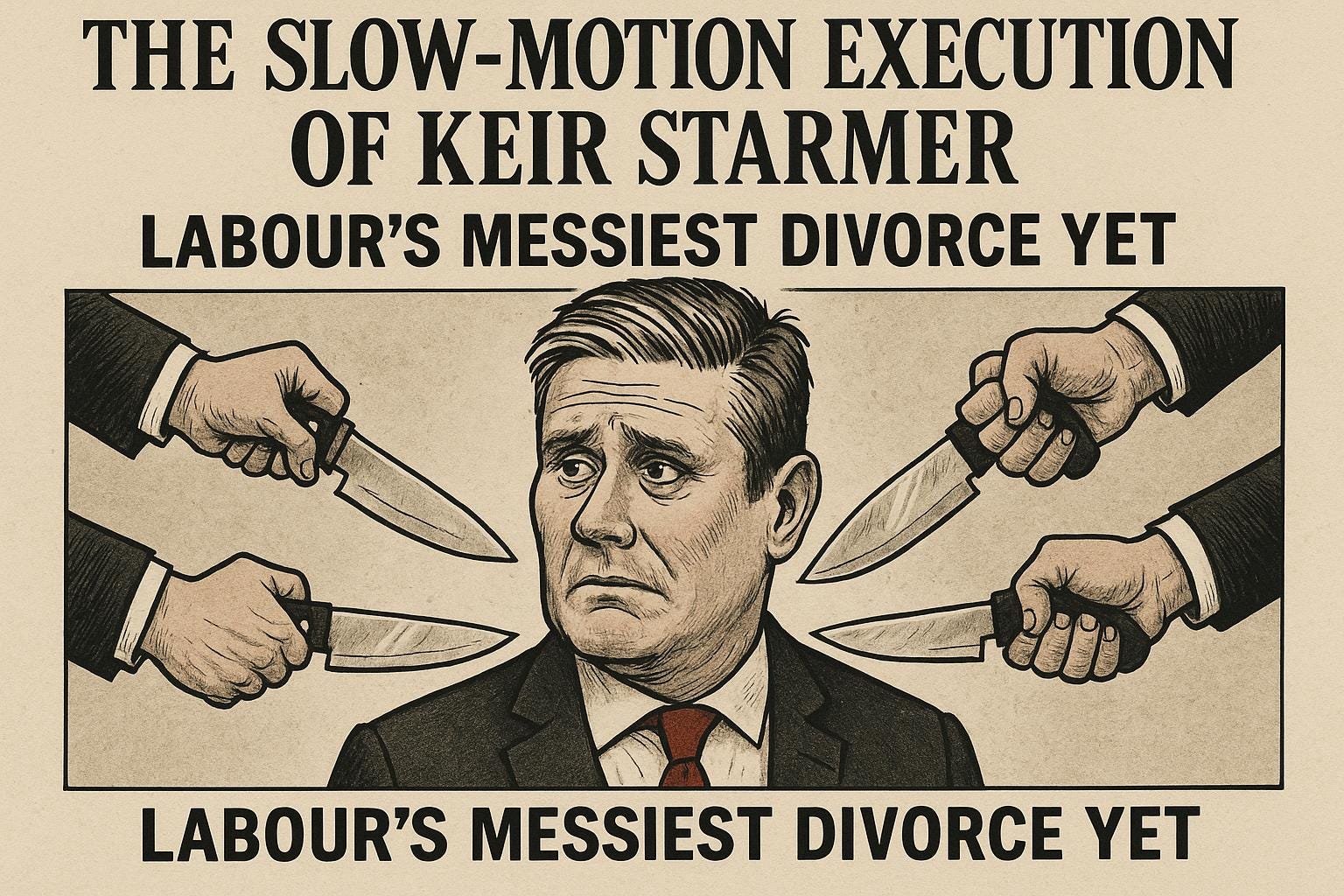
But fair or not, the arithmetic is brutal. Labour MPs are nervous. Labour donors are quiet. Labour focus groups are, one imagines, absolutely harrowing. And so the knives — those most British of political instruments — are out. The question is no longer whether Starmer goes. The question, and this is where it gets genuinely magnificent, is when.
Because Labour, being Labour, cannot even agree on how to sack their own leader without splitting into factions.
The Great Timing Debate: Fast Knives vs. Slow Knives
On one side, you have the Labour right. Blairite, professionalised, deeply concerned about electability, and utterly convinced that the longer Starmer limps on, the worse it gets. Their argument is simple: rip off the plaster, get a new leader, draw a line, move on. They are not without logic. Every week Starmer remains, another Reform poster goes up in another former safe seat.
On the other side — and this is the bit that would be funny if it weren’t so consequential — you have the Labour soft left, who also want Starmer gone, but not yet. Not until Andy Burnham is ready. Andy Burnham, the Mayor of Greater Manchester, the man with the hair, the Everton shirt, and the carefully cultivated aura of a politician who has been quietly waiting for everyone else to implode. Which, to be fair to him, they absolutely have.
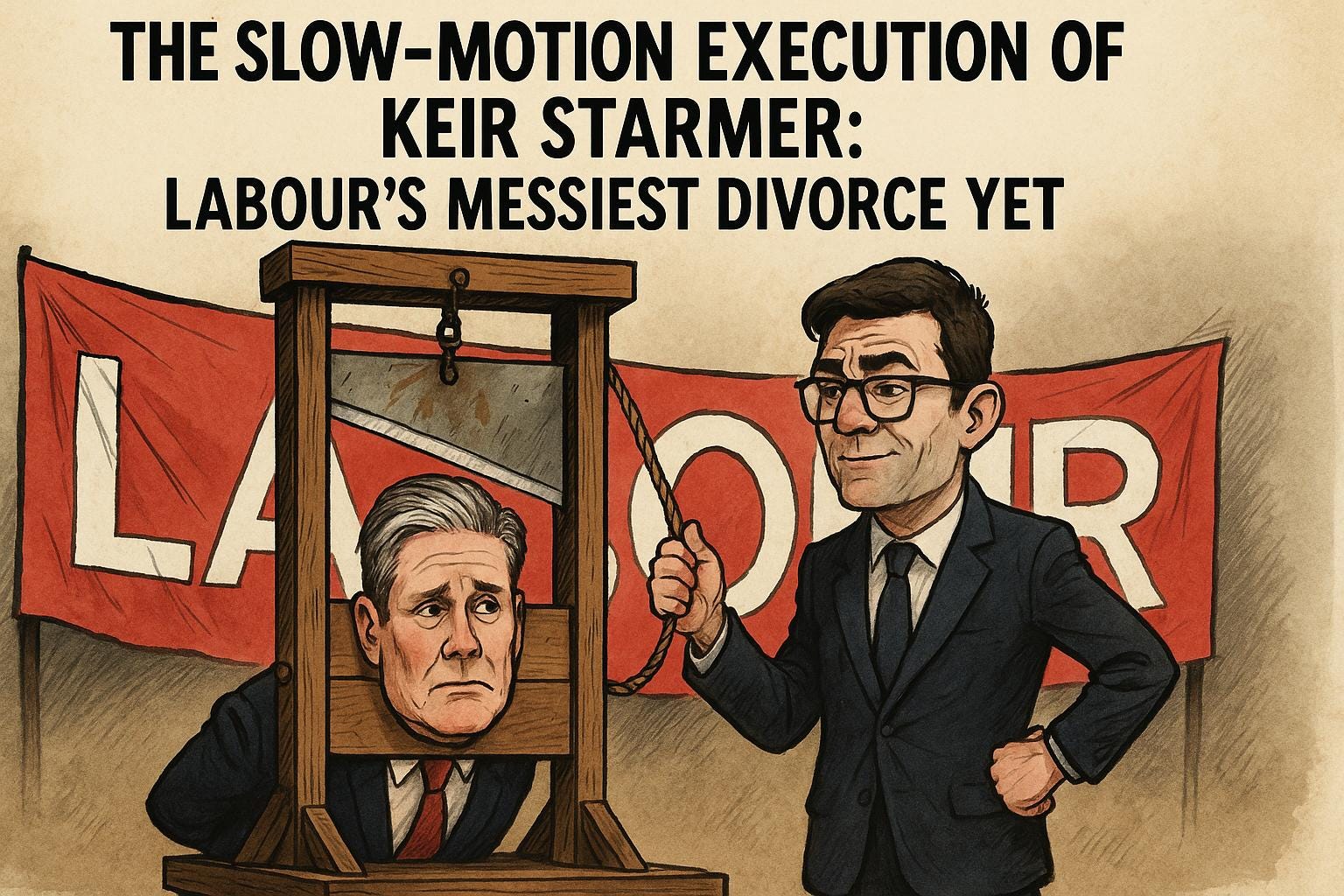
The soft left’s calculation is almost admirably cynical: Burnham cannot stand for Labour leader unless he first stands down as Mayor, triggers a by-election, wins a parliamentary seat, and then formally enters the race. This takes time. Months, possibly. And so their position — stated with straight faces — is that Starmer should remain as a kind of political caretaker, a crash-test dummy in a suit, keeping the seat warm until Burnham can get himself through the door.
Starmer, one suspects, is less than thrilled about this particular arrangement.
Andy Burnham: The Man the Moment Has Been Building Towards
Burnham himself has been characteristically coy — a man carefully not confirming anything whilst doing absolutely nothing to discourage the speculation. He gave a speech recently about the future of the country that was so obviously a leadership pitch that it practically came with a campaign rosette. His supporters in Westminster talk about him the way people talk about a restaurant they’ve been trying to get into for years: slightly obsessive, utterly convinced it will be worth the wait.
Whether Burnham is actually the answer to Labour’s problems is, of course, another question entirely. He is popular in the North, credible on public services, and possesses the rare political skill of seeming like an actual human being. But the distance between Mayor of Manchester and Prime Minister is not merely geographical. It is enormous. And the idea that Labour can successfully execute a mid-term leadership transition, fight off Reform and the Greens, and rebuild a coalition capable of winning a general election is, let us say, ambitious.
The State of British Politics, Briefly Summarised
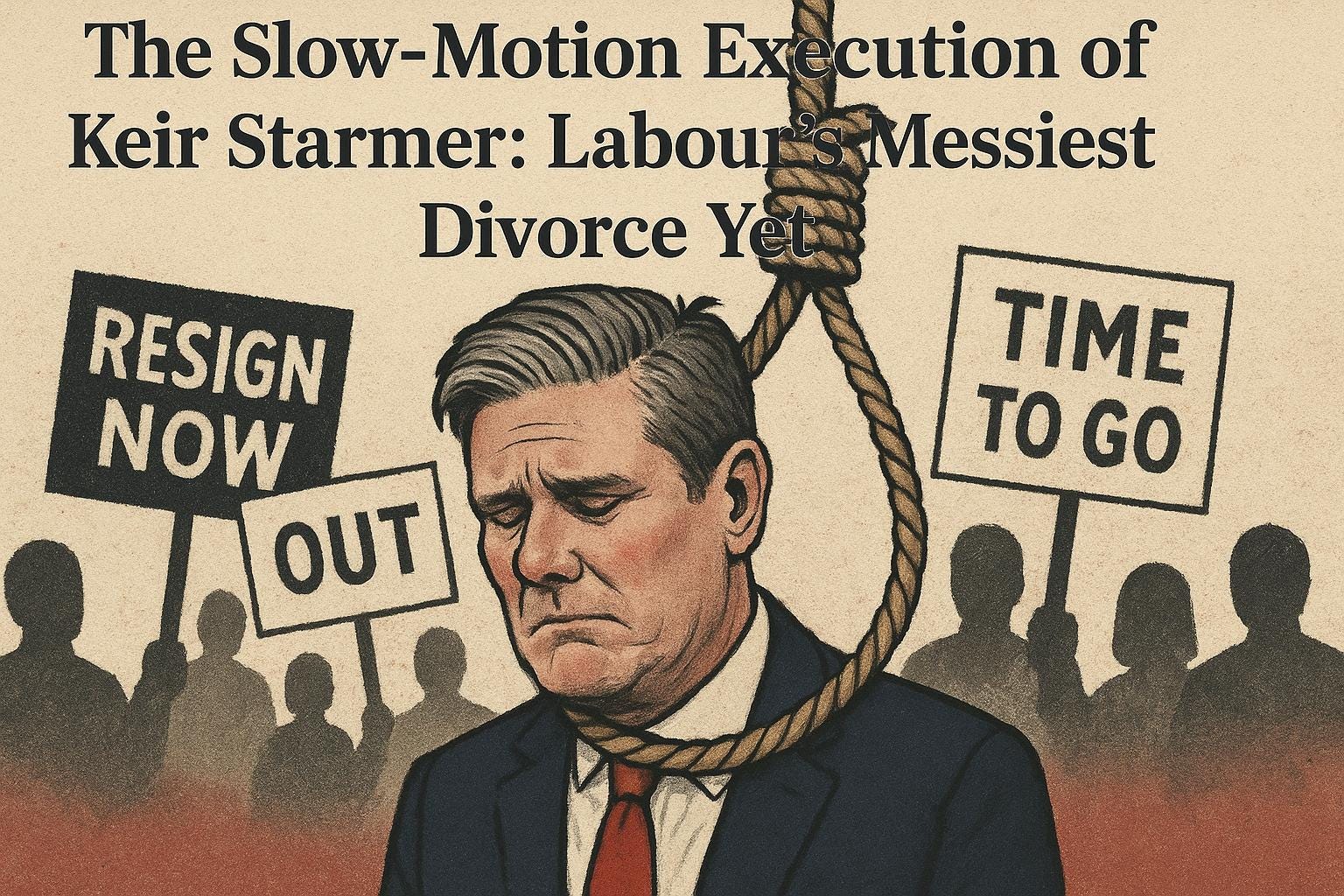
So here we are. A Prime Minister whose own party is arguing not about whether to replace him but about the optimal scheduling. A resurgent far-right that has figured out how to win elections. A Green party that is quietly becoming a serious force. And somewhere in Manchester, a man with very nice hair checking his diary and wondering how quickly he can find a safe seat.
British politics has always had a talent for farce. But even by its own impressive standards, this is something special. Keir Starmer’s political obituary is being written in real time, by his own colleagues, who are arguing in the footnotes about the font size. The execution is happening. They just can’t agree on when to pull the lever.
In the meantime, the country waits. Reform gains. The Greens grow. And somewhere in Westminster, a very tired man in a very expensive suit stares out of a very large window and wonders how it all went so wrong, so fast.
The answer, Keir, is the elections. It’s always the elections.
Keep up to date with The Letts Journal’s latest news stories and posts at our website and on twitter.