

The Synchronised Flailing: Local Elections and Mid-Term Terror Inspires Political Whipsawing!
Two democracies. Two leaders. One shared business model: announce something, panic, reverse it, blame the weather. The transatlantic U-Turn Olympics are now in their second exhilarating year.

Once upon a time, governing a Western democracy was a gentle, civilised affair: white papers, sober committees, the occasional dramatic resignation over a cheese-related budget item. Then mid-terms smelled a microphone. What followed has been less a political cycle and more a transatlantic interpretive dance — Britain and America, hand in hand, performing the exact same nervous breakdown in stereo.
On the British side: Sir Keir Starmer, a former human rights lawyer who governs as if every policy might one day be admitted as evidence against him. On the American side: Donald J. Trump, a former property developer who governs as if every policy is a press release that has not yet been refined by a focus group of one (himself, in a mirror, before breakfast). Different countries. Different ideologies. Different hairdressers. Identical problem: the electorate has had quite enough, thank you, and has begun composing its strongly-worded letter.
Welcome to the Synchronised Flailing, where the polling collapses, the policies wobble, the tariffs rise and fall like an unusually drunk barometer, and somewhere in the middle of it all King Charles III glides serenely between capitals like the world’s most highly trained therapy spaniel, dispensing soft power and quietly hoping nobody asks him about the slavery thing.
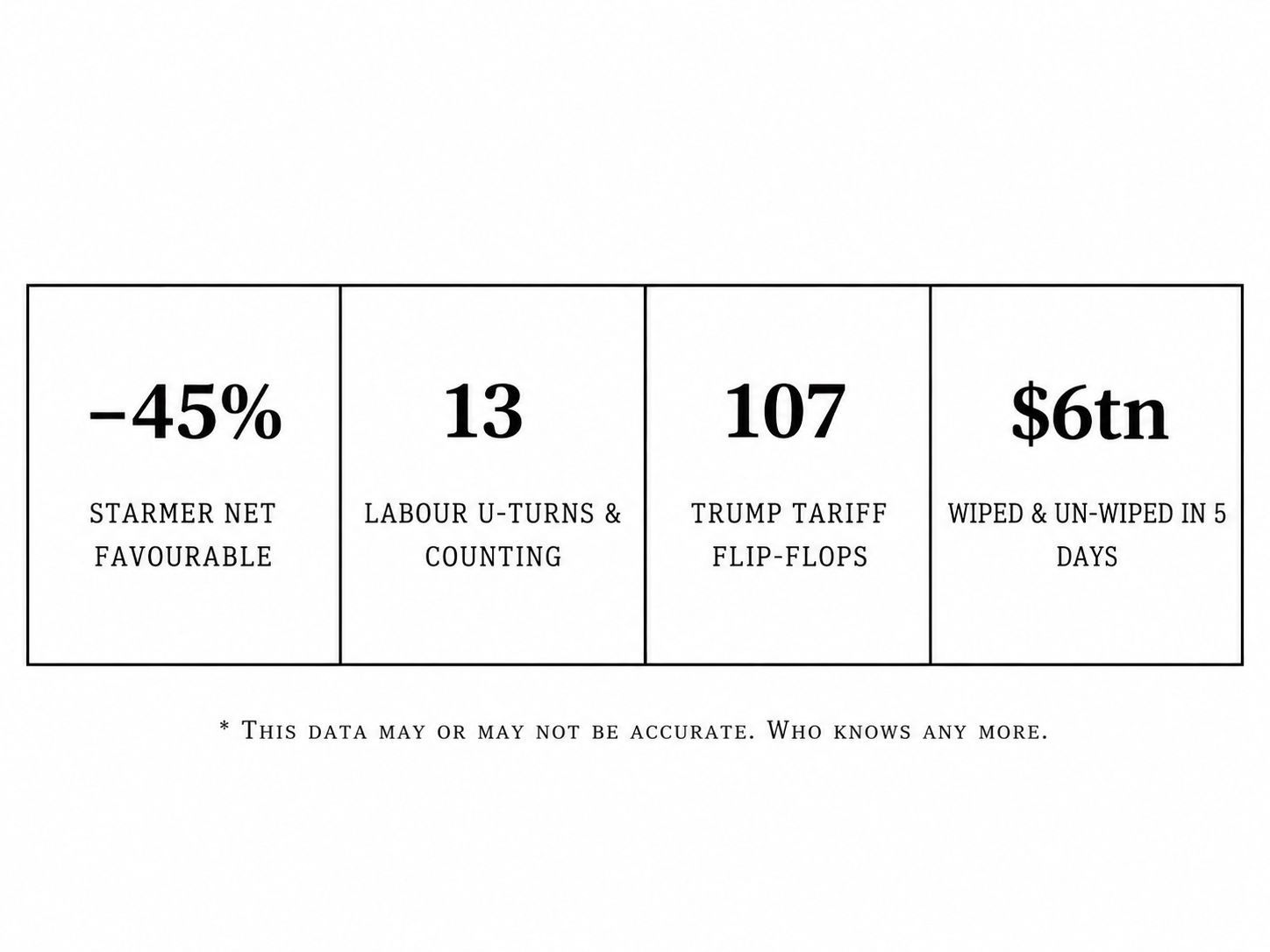
Let us begin with the numbers, because the numbers are doing comedy on their own. Starmer’s net favourability sits at minus forty-five (we think). Three-quarters of Britons view him unfavourably (we also think). He has, in less than two years, contrived to poll worse than Rishi Sunak, a man whose entire political brand was being marginally more popular than mild food poisoning. Starmer is currently outscored in the affection stakes by Nigel Farage whose political career resembles one of those novelty birthday candles you genuinely cannot blow out, no matter how many summit meetings you hold or hard hats you put on. This is not a rough patch. This is being booed at your own birthday party.
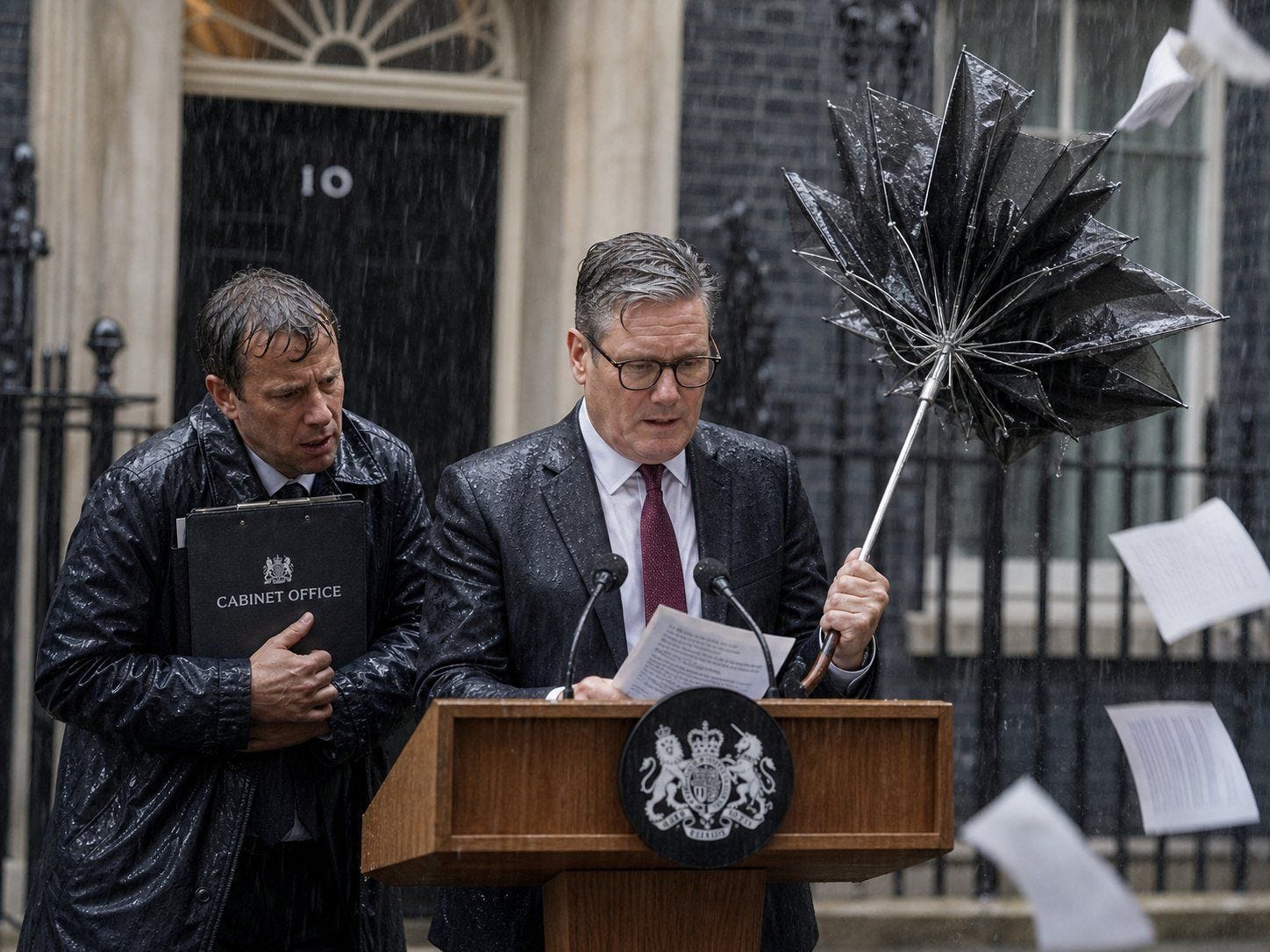
The British problem, in essence, is that Starmer arrived in July 2024 with a thumping majority and one core argument: we are not the Conservatives. This is, to be fair, a strong argument. It is also, alas, not a manifesto. It is the political equivalent of winning Bake Off by entering a Mr Kipling and pointing out that at least it isn’t on fire. The U-turns began approximately five minutes after the moving van left Downing Street and have not stopped since.
Behold the Greatest Hits. Winter fuel payments: removed from pensioners, then partially restored after a national outbreak of “I’m telling Mum.” Two-child benefit cap: reinstated, then scrapped at a casual £14 billion after a back-bench mutiny. Farmers’ inheritance tax: announced, attacked by a tractor convoy in central London, quietly modified before the next muddy boot hit Whitehall. Pub business rates: doubled, frozen, semi-unfrozen. Digital ID: mandatory, then optional, then “let’s not talk about it.” The grooming gangs national inquiry: “absolutely unnecessary,” then absolutely necessary. Thirty local elections: postponed for “lack of resources,” then un-postponed after legal advice politely pointed out this was, technically, illegal. Politico now maintains a live tracker complete with days-to-reversal. It is one of the only growth industries left in Westminster.
One Labour minister, asked about all this in January, gave perhaps the most beautifully Whitehall reply ever recorded: U-turns, he explained, are “preferable if you need to move on from policies which are high salience and low approval.” Translation: we said the wrong thing, then changed it, and we shall keep doing this until the next election or until we run out of policies, whichever comes first. The British call this “governing.” Everyone else calls it Tuesday.
Cross the Atlantic and the choreography continues, only louder, with more capital letters, and an ALL-CAPS Greek chorus on Truth Social. Trump returned to the Oval Office in January 2025 on a 52 percent approval rating and a vibe of bracing managerial confidence. Sixteen months later: 40 percent approval, 57 percent disapproval, and a tariff policy so labyrinthine that Yale researchers (actual humans with PhDs — sorry Claude) sat down and counted the flip-flops. They got to 107. In two months. Often same-day. At one Yale CEO Caucus, executives cringed through seven separate tariff reversals during a single three-hour event, which is roughly one reversal per artisanal canapé.
“Yale researchers counted 107 tariff flip-flops in two months. At one CEO summit, seven happened in three hours. Roughly one reversal per canapé.” We think...
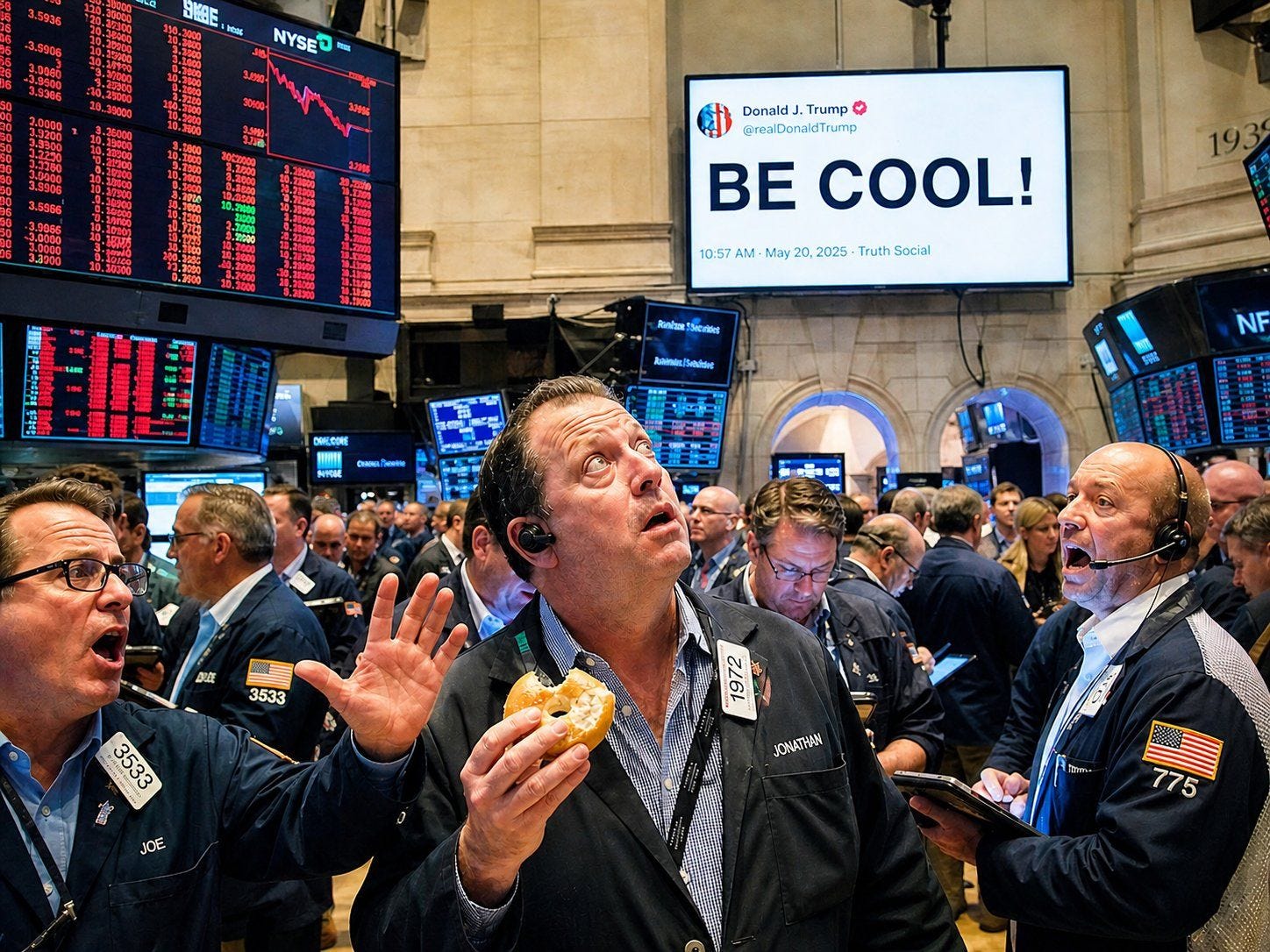
The masterwork came on April 9, 2025 — a date that should be carved on a small commemorative plaque outside the New York Stock Exchange. The Dow had hemorrhaged 3,900 points in two days, something it had never done before in its entire 130-year career. Six trillion dollars in market value: gone. Bill Ackman warned of “economic nuclear winter.” That morning, with markets still in freefall, the President of the United States posted on his own social media platform: “BE COOL!” Minutes later: “THIS IS A GREAT TIME TO BUY!!!” A few hours after that, he announced a 90-day tariff pause, and the S&P 500 had its best single day since 2008. The Nasdaq had its second-best day in its entire history. Asked later how he came to this decision, the leader of the free world explained: “I thought people were jumping a little bit out of line, they were getting yippy.”
Yippy. The most powerful office on Earth, $6 trillion of capital sloshing in the balance, and the working diagnosis was: yippy. The bond market, Trump added approvingly, was “beautiful.” Democrats began muttering darkly about insider trading. Trump went to play golf. This is not a satire of governance. This is governance.
The truly impressive feat is that two governments operating from opposite political philosophies — one a centre-left technocracy with a backbench problem, one a populist circus with a Truth Social problem — have managed to converge on the exact same governing model: announce, panic, reverse, blame, repeat. The British version is delivered in the hushed apologetic tone of a man telling you your hire car has a small dent. The American version is delivered like a fireworks display being run by the fireworks. The destination is the same.
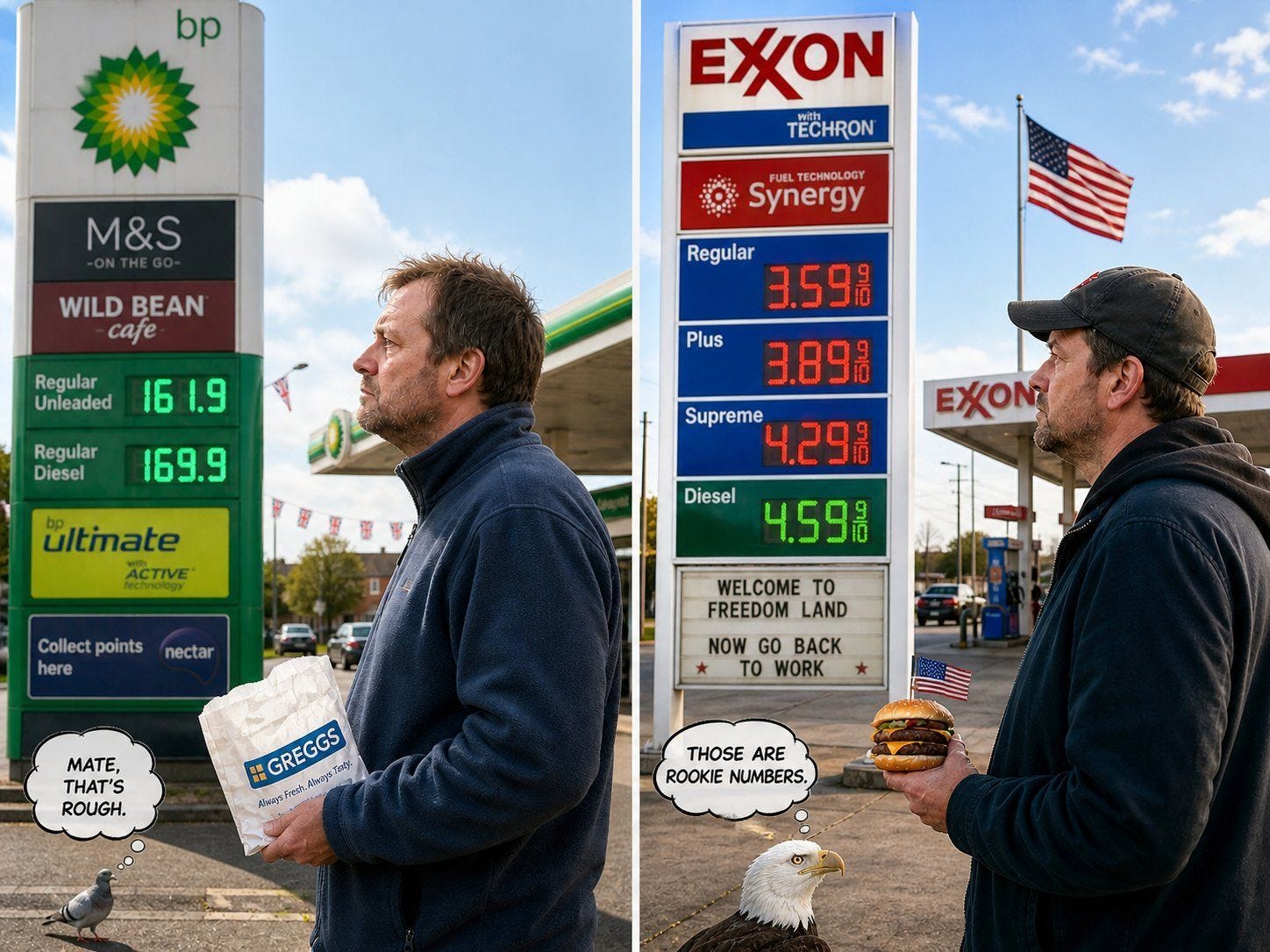
The reason is, of course, the economy — that great democratic fact-checker that no amount of vibe-shifting can outrun. Every Western voter currently doing a weekly shop has noticed the same thing: a trolley containing what their parents would have called “Monday” now costs what their parents would have called “Christmas.” Energy bills require a small period of mindfulness before opening. Petrol prices have become a national mood ring. Rents are an inside joke that nobody is laughing at. Mortgages are a love letter from your past self that you cannot afford to reply to. And into this tinderbox both governments have trotted with their little watering cans of fiscal tweaks and PR offensives, and watched, baffled, as the watering cans turn out to be petrol.
Oil shocks remain the joker in the deck. A single Strait of Hormuz wobble, a single pipeline cough, and the pump price moves within a fortnight, the polls within a month, and the parliamentary questions within a week. It is the most reliable transmission mechanism in modern democracy. More dependable than any manifesto pledge. Considerably more punctual than the trains. Meanwhile the stock market, having priced AI as if every chatbot will personally cure cancer by Christmas, sits at altitudes that even paid-up cheerleaders are now describing as “interesting.” On both sides of the Atlantic the bubble inflates, the leaders watch it with the specific facial expression of someone smelling gas at a dinner party but not wanting to make a fuss, and the economists quietly update their CVs.
Looming over the American half of the Synchronised Flailing is November, which is a reckoning so visible from space that even Republicans have stopped pretending they cannot see it. Democrats lead the generic ballot by ten points. Six special elections in 2025-26 swung by an average of fifteen points toward the Democrats. Iowa and Texas are no longer regarded as safe Republican bets. Let me say that again, slowly: Iowa and Texas. North Carolina, Maine, Ohio, Alaska all wobbling. Trump’s approval on inflation is 30 percent. On healthcare: 29. On the economy: 37. His “net buzz” — a real polling metric, despite sounding like a discarded reality show is at its worst reading of the spring. If the House flips, his second term becomes a sustained mood board enforced via executive order, with Congress doing little except investigating him with cheerful enthusiasm until January 2029.
In Britain there is no midterm. There is only the slow, drizzling drip of local elections, by-elections and YouGov, each arriving like a polite Post-it note from the country saying “Have you considered going?” Reform UK, which was supposed to be a colourful protest movement, has become something structurally inconvenient — a party that now eyes Labour seats with the energy of a property developer who has just realised the postcode is undervalued. The next general election is, technically, 2029. Whether Starmer leads Labour into it is a question senior Labour figures answer with a thoughtful pause, a change of subject, and a fresh cup of tea so strong it could prosecute someone. Particularly someone from Manchester.
Into all this glides King Charles III deployed by both governments with the diplomatic enthusiasm of a man who has been receiving extremely awkward briefings since the late 1970s and has cultivated, over the decades, an ChelseaFC-grade ability not to react. The state visit to Washington produced gold coaches, Grenadiers, soft power, and one (1) measurable bump in Starmer’s approval — from -34 to -17 in a single month, which felt at the time like resurrection and turned out to be a lung-full of helium. By May it was back to -29. Even the Crown, it transpires, has a limited warranty when the issue is the weekly shop.
“Even King Charles cannot reverse this. The Crown has many gifts. Restoring the polling of a Prime Minister whose own backbenchers are leaking against him at lunchtime is not among them.”
And so, as we sit in the early days of May 2026, the Synchronised Flailing continues — Britain and America performing in perfect, dismal unison their respective acts of political self-Heimlich. Trump posts. Starmer scraps. Tariffs rise, fall, rise again, settle, are denied, re-emerge as something else with a slightly different name. Winter fuel is taken, given, half-given, sort-of-given, and then taken again at the snap of a Whatsapp. Both leaders are governing with the specific grim focus of a man who has noticed the iceberg at last and concluded that turning the ship would simply be too tricky.
The Crown cannot save them. The economy will not save them. The polling will not recover before the relevant electorate gets its turn at the bat. History will, eventually, judge. The opinion polls are considerably less patient — and on the available evidence, neither is anybody else. In the meantime: BE COOL. The barnacles are being scraped. There will be a transition cost and transition problems, but in the end it’s going to be a beautiful thing. These are not things we made up. These are sentences said, in earnest, by actual people running actual countries. And on that note, this column is going for a long lie-down with a strong drink and the curtains firmly drawn until November.
*It should be noted that our data may or may not be accurate. Who knows any more. And yes, we too like to hallucinate (the old fashioned way).
Keep up to date with The Letts Journal’s latest news stories and posts at our website and on twitter.